
How do I get a teenager with ADHD to put their phone down and sleep?
Build a workable night-time phone plan while checking whether the phone is delaying sleep or filling time when sleep has not arrived.
The short answer
Discuss the phone during the day, not during the final argument at night. First separate what the device is doing: active games or conversations may delay settling; notifications may wake the teenager; audio may help them settle; or the phone may fill time because they are not sleepy. Agree a two-week experiment covering when active use ends, where the phone stays, how genuine safety or health needs remain accessible and what fills the gap. Record actual sleep onset, waking and daytime function rather than treating surrendering the device as success. Evelina London advises teenagers to stop phone or tablet use at least an hour before bed and charge the phone outside the bedroom, but a family may need to work towards that recommendation. If the teenager remains unable to sleep, assess the sleep problem itself.
What helps, in short
- Separate phone use that delays sleep from phone use because sleep has not arrived.
- Agree the plan in daylight and preserve genuine safety, health and contact needs.
- Replace the activity as well as removing the device.
- Judge the experiment by sleep and daytime function, not obedience.
- Tell the prescriber if ADHD medication appears to change sleep.
Taking the phone away may end phone use for one night. It does not tell you whether the device delayed sleep, whether your teenager was using it because they were already awake or how they will eventually manage the boundary themselves.
Build a short experiment together in daylight.
Ask what the phone is doing at night
Separate four possibilities:
- Games, videos or conversations keep offering another reason to remain engaged.
- Notifications interrupt sleep after it begins.
- Audio, contact or familiar content helps the teenager feel safe enough to settle.
- The teenager is not sleepy and uses the phone to fill a long wakeful period.
It may do several at once. Ask what they use, when they feel sleepy and what happens on nights when the phone is elsewhere. Check whether it is also an alarm, health device, communication aid or essential contact route.
Do not start with “Your phone is ruining your sleep.” Try: “Mornings are becoming impossible. I want us to test which part of the phone routine is affecting sleep, without assuming it explains everything.”
Write four parts of the plan
Agree:
- when active use ends;
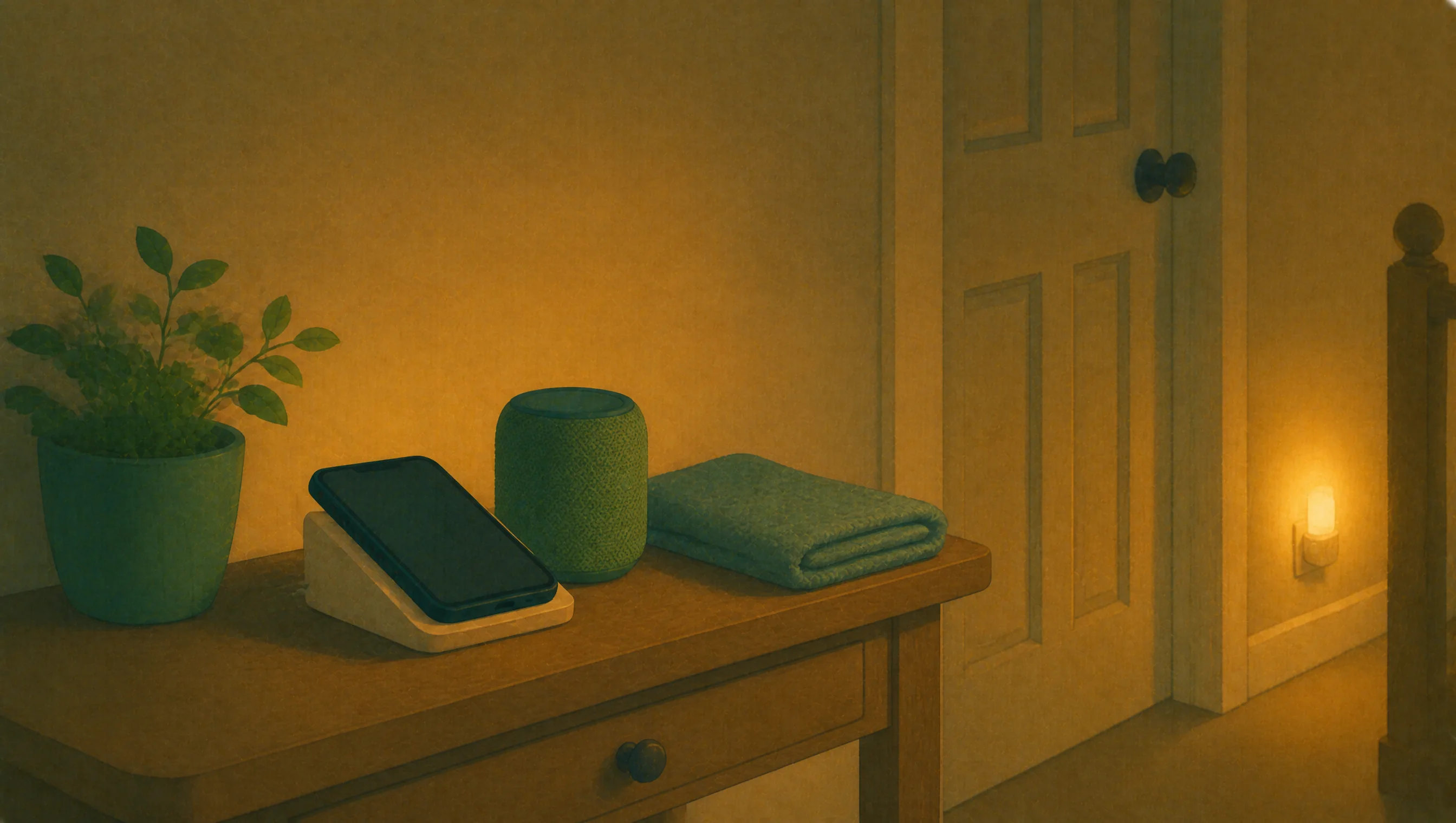
- where the phone stays;
- how genuine exceptions work;
- when you review the result.
Evelina London advises teenagers to stop phone or tablet use at least an hour before bed and charge the phone outside the bedroom.1 Treat that as a clear health recommendation to work towards, not proof that every teenager can move from falling asleep with a phone to an unsupported hour immediately.
A plan might say: “At 10pm, active apps close and the phone charges on the landing. Calls from Mum remain allowed. We will record sleep for two weeks.” Make fixed points honest and offer control over details that are genuinely flexible.
Use night settings to reduce notifications, but do not let a technical setting replace the agreement. If the phone must remain for medical or safety reasons, decide which functions remain available and how distracting functions are limited without compromising that purpose.
Fill the gap
Removing a highly accessible activity leaves a transition and empty time. Agree an alternative the teenager can begin without much effort: familiar audio, drawing, a shower, a simple repetitive activity, preparing one morning item or quiet time with another person.
Avoid turning the final hour into compulsory self-improvement. A teenager who dislikes reading does not need a novel prescribed as the price of losing their phone. The replacement needs to be lower-arousal, tolerable and available on an ordinary night.
Keep the sequence short: “Phone charging, shower, audio, bed.” If audio helps, use a speaker, downloaded track or another agreed arrangement that does not reopen messages and feeds.
Plan the transition into the final activity as carefully as the activity itself. Give a warning linked to a natural endpoint, let the teenager send a brief goodnight where appropriate and avoid starting another family discussion after the device is away. The plan is easier to follow when it closes one activity cleanly rather than dropping the teenager into an unexplained hour.
Hold the boundary without making it the whole relationship
If your teenager objects, ask which part is inaccessible: timing, missing friends, fear of lying awake, charging location or loss of an essential function. Change a workable detail without pretending the whole plan is optional.
Avoid searching the room, adding unrelated punishments or reopening the discussion every night unless immediate safety requires action. State the plan, follow the proportionate response you agreed and return to the problem in daylight.
Adults can use the shared charging place where realistic, while naming why responsibilities sometimes differ. Credibility comes from honesty, not identical rules.
If the plan is not followed, record why before redesigning it. Forgetting, losing track of time, a distressed friend and quietly rejecting the rule are different problems. A proportionate response can hold the boundary while still using that information.
Measure sleep, not surrender
For two weeks, record when active use ended, estimated sleep onset, night waking, final waking and daytime alertness. Do not use the record to catch your teenager out.
If sleep begins earlier and mornings improve, the experiment tells you the phone routine mattered. If the phone is away and sleep still does not arrive for hours, investigate timing, anxiety, discomfort, medication and other sleep concerns. Check for a persistently delayed sleep pattern rather than escalating confiscation.
Tell the prescriber if ADHD medication appears to change sleep. NICE recommends monitoring sleep changes, for example with a diary, and adjusting medication accordingly.2 Families should not change dose or timing themselves.
Speak to the GP when sleep difficulty persists or substantially affects health, education, mood or safety, and seek prompt advice for pain, loud snoring, choking, breathing pauses, unusual episodes or marked daytime sleepiness.
The goal is a phone plan your teenager can understand and gradually own, alongside proper attention to the sleep problem that remains when the screen goes dark.
Footnotes
-
Evelina London’s teenage sleep guidance recommends stopping phone or tablet use at least an hour before bed and charging the phone outside the bedroom. ↩
-
NICE NG87 recommends monitoring changes in sleep pattern during ADHD medication treatment and adjusting medication accordingly through clinical care. ↩
Sources and further reading
- [1] Evelina London Children’s Healthcare. How to sleep well for teenagers (accessed 4 August 2026).
- [2] NICE. Attention deficit hyperactivity disorder: diagnosis and management (accessed 4 August 2026).
The Family Reset System
Need more than one answer?
Membership opens the full FamilyFX Library and brings the articles together with eight modules, fourteen deep guides, practical packs, document-building tools and My FamilyFX. It costs £79.99 a year, and NeuroFX patients can use an access code for a free first year.
See what is included →