
Why does my child struggle with handwriting, buttons and bike riding?
How coordination difficulties can affect handwriting, dressing, eating, play and confidence, with practical support and routes to DCD assessment.
The short answer
Persistent difficulty with handwriting, cutlery, dressing, ball skills, balance or learning movement sequences can reflect developmental coordination disorder (DCD), also called dyspraxia, but individual tasks have many possible explanations. Look for a pattern across daily activities, the effort and time involved, and whether the child has had suitable opportunity to learn. Make tasks accessible now by reducing unnecessary motor load, teaching one component at a time and offering alternatives to handwriting or fast changing. Speak with the SENCO, GP or health visitor when coordination is persistently affecting school, self-care, play or confidence. DCD diagnosis usually involves a paediatrician working with an occupational therapist or physiotherapist and is not normally definite before age five.
- DCD affects motor coordination and everyday activity, not effort or intelligence.
- One untidy task does not identify a coordination disorder.
- Reduce motor barriers while the child learns the skill in manageable parts.
- Assessment considers movement, development, opportunity and daily impact.
- New loss of skills, weakness or sudden gait change needs medical assessment.
One child avoids buttons and arrives at school already exhausted from dressing. Another knows the answer but cannot write it before the class moves on. A third is repeatedly chosen last for games and says they hate sport.
The visible result can look careless or reluctant. The hidden work may be motor planning, balance, timing, force, hand control and coordinating several movements in sequence.
What DCD means
Developmental coordination disorder, or DCD, affects physical coordination. It is also known as dyspraxia, although NHS guidance says healthcare professionals generally prefer DCD because “dyspraxia” can have several meanings [1].
DCD can affect gross motor skills, such as running, jumping, balance, stairs, catching and bike riding. It can affect fine motor skills, including cutlery, scissors, drawing, handwriting, fastenings and shoelaces [3]. The important feature is a persistent effect on age-expected everyday activities, not occasional clumsiness.
DCD does not describe intelligence or motivation. A child may understand a task fully and be unable to make their movements carry it out efficiently.
Look across tasks and time
Handwriting alone has many possible explanations: limited teaching, pain, joint mobility, attention, visual difficulty, language load, spelling effort or an unsuitable writing position. Bike riding depends on opportunity, confidence and practice as well as coordination.
Look for a broader pattern:
- self-care takes much longer than expected;
- new movements need extensive repetition;
- the child drops, spills or bumps into things frequently;
- writing is slow, painful or consumes all their attention;
- ball games and playground movement are persistently difficult;
- several steps collapse when performed together; and
- the child avoids tasks after repeated failure or teasing.
Record what the child can do with more time, modelling, adapted equipment or one-to-one teaching. That shows both need and learning potential.
Make access possible now
Do not require the child to master the motor barrier before joining the wider activity.
At school, this may mean typing or dictating longer work, reducing copying, providing printed notes, allowing more time, changing PE tasks and assessing subject knowledge separately from presentation. At home, try clothes with manageable fastenings, stable seating, suitable cutlery and enough time to dress without a running commentary.
These adjustments do not abandon skill development. They stop every morning, lesson and meal becoming the practice session.
When teaching a skill:
- Agree that the skill matters to the child.
- Make the environment stable and comfortable.
- Demonstrate one component clearly.
- Practise briefly and frequently.
- Keep the same words and sequence.
- Stop before pain, humiliation or exhaustion.
Progress may come through a different method rather than more pressure.
Analyse the task before buying equipment
Families are often offered a pencil grip, wobble cushion or special cutlery before anyone has identified the difficult part. Equipment can help, but only when it answers a defined need and the child can use it comfortably.
Break the task down. For handwriting, check seating, page position, copying distance, pencil pressure, pain, letter formation, spelling load, idea generation and the amount expected. A child may form letters adequately in isolation and lose control while copying from a board. The useful change could be printed notes rather than another grip.
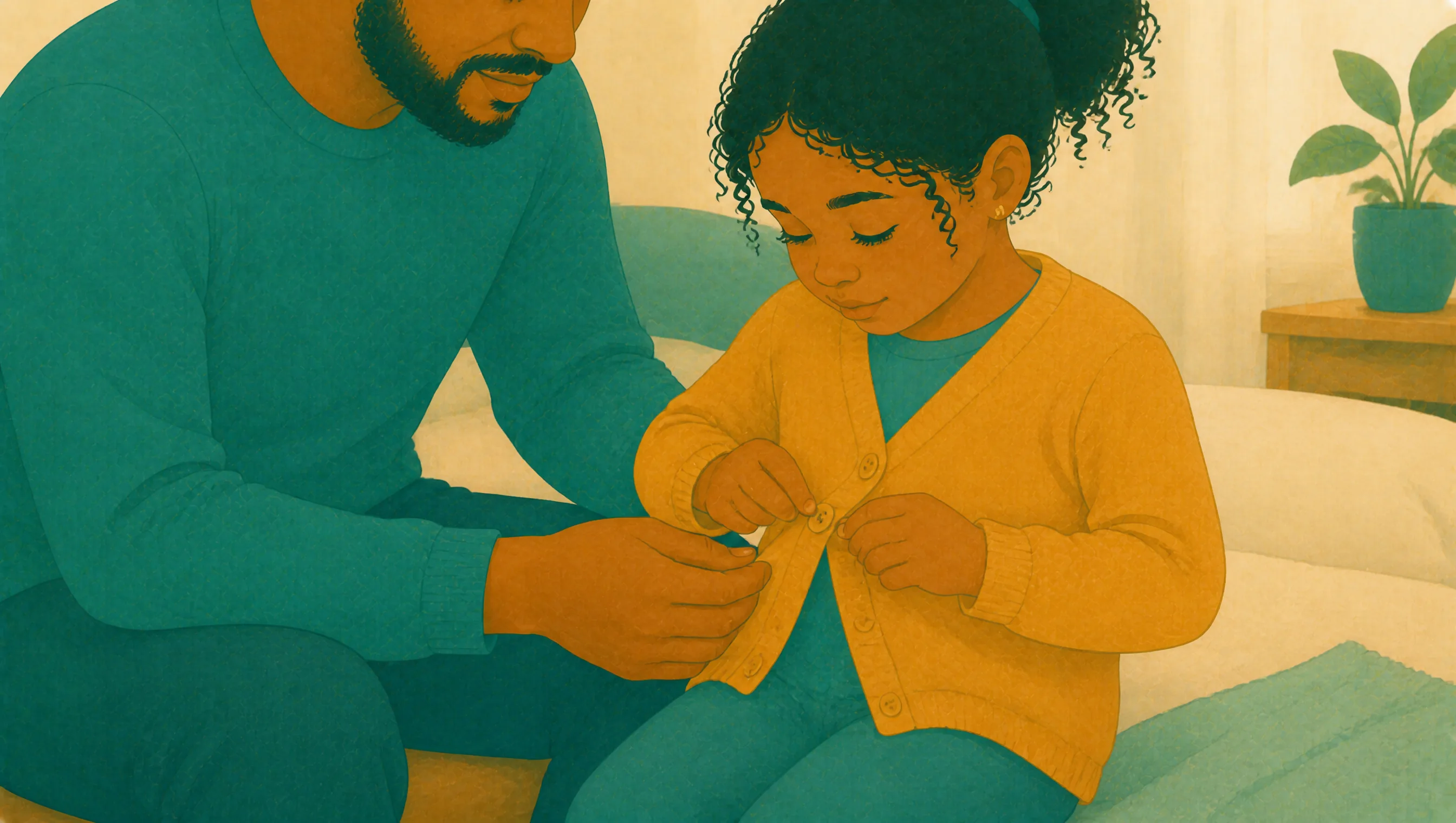
For dressing, notice whether the barrier is balance, finding the opening, finger control, left-right orientation, sequencing, fabric sensation or time pressure. Sit down, lay clothes in order, stabilise the garment or replace one fastening. Change one part and observe the effect.
Bike riding combines balance, steering, pedalling, braking, body awareness, visual attention and confidence in a moving environment. A balance bike or quiet practice area may isolate part of the skill. It is also acceptable for a child to choose another form of movement. Riding a bicycle is not a test of character or family effort.
Ask an occupational therapist or physiotherapist for individual advice when the task is important, persistent and difficult to adapt safely. Online exercise lists cannot assess strength, joints, vision, pain or the reason a movement is hard.
Account for effort and fatigue
A motor task can be completed and still cost too much. Notice grip tension, slowed pace, repeated corrections, aching, loss of concentration and what becomes inaccessible afterwards. A child who writes one neat paragraph may not be able to sustain the same method across a lesson. Record quantity, time, support and discomfort rather than keeping only the finished page.
Build pauses before control deteriorates. Longer time is useful only if the child can use it without extending pain or exhaustion. Sometimes the better adjustment is less handwriting, prepared equipment or another way to show knowledge. At home, completing dressing independently may matter less than having enough capacity left to eat breakfast and enter school.
Ask about embarrassment privately. Children may hide difficulty, rush or refuse help because equipment and adult attention make them conspicuous. A discreet adjustment chosen with the child is more likely to support participation than a technically suitable tool they cannot bear to use in front of peers.
Protect participation and confidence
Motor difficulty can affect friendships and identity long before anyone names it. A child who avoids PE may be protecting themselves from public failure. A child who refuses cutlery may be tired of spilling food under observation.
Ask, “Which part is hardest?” rather than “Why won't you try?” Offer movement for enjoyment without making competition the entry price. Swimming, walking, dance, climbing, adapted cycling or individual practice may be more accessible than a fast team game. The movement guide offers ways to build participation around the child's actual starting point.
Do not compare siblings' independence. Faster dressing is not the only worthwhile outcome; privacy, reduced prompts and arriving regulated may matter more.
What assessment involves
The NHS says families can speak with a GP, health visitor or school SENCO and may be referred to an occupational therapist, paediatrician, physiotherapist or another professional [1, 2]. Diagnosis usually involves a paediatrician, often working with an occupational therapist. Assessment considers motor skills, developmental and medical history, daily impact and whether another condition better explains the difficulty [2].
A definite DCD diagnosis does not usually happen before age five because young children's development varies [1, 2]. Younger children can still receive help for their observed needs.
Bring examples from home and school:
- tasks affected and time taken;
- pain, fatigue, falls or injury;
- milestones and early development;
- teaching and practice already provided;
- tools or conditions that help;
- the child's account; and
- any attention, language, learning or sensory needs.
DCD can coexist with ADHD, autism and dyslexia [3]. Assessment should not force one condition to explain the whole profile.
Know when the pattern is not developmental
DCD begins during development. New loss of a movement skill, sudden unsteadiness, a new gait change, weakness, marked pain or rapidly worsening coordination is a different clinical question. NICE recommends immediate referral for a new-onset gait abnormality and urgent or immediate assessment for certain sudden neurological changes [4].
Seek medical advice promptly rather than waiting for a routine school assessment when the child has changed acutely.
A useful next step
Choose one daily task with the greatest cost. Separate its purpose from its motor method. If the purpose is showing history knowledge, let the child type while handwriting is considered separately. If the purpose is getting dressed, choose accessible clothes while one fastening is practised at a calm time.
Write down what changed in time, independence, pain and confidence. That small record gives school and health professionals a clearer picture than “clumsy”, and it gives the child a day that is more workable now.
Sources and further reading
- [1] NHS. Developmental co-ordination disorder (dyspraxia) in children (accessed 4 August 2026).
- [2] NHS. Developmental co-ordination disorder: diagnosis (accessed 4 August 2026).
- [3] NHS. Developmental co-ordination disorder: symptoms (accessed 4 August 2026).
- [4] NICE. Suspected neurological conditions: recognition and referral (accessed 4 August 2026).
