
How do I build an external brain for my child at home?
How to place plans, cues, materials and checks where a child can use them instead of expecting every task to be held in memory.
The short answer
An 'external brain' is informal shorthand for putting information and support into the environment. Start with one recurring task, not the whole household. Map what the child currently has to remember, notice, decide, find and check. Then move one or two of those jobs outside their head: keep materials at the point of use, use one trusted place for plans, pair a cue with the next action, and make finished visible. The child should be able to find and understand the system without an adult translating it each time. Test it on ordinary difficult days, remove duplicate reminders and change the part that fails. Independence can include using tools, automation and another person's agreed support; the goal is reliable participation and growing control, not unsupported performance.
- “External brain” is shorthand for an environmental support system, not a clinical treatment or diagnosis.
- Begin with one high-impact recurring task and map the hidden demands.
- Give each item, instruction and future action one trusted home where possible.
- A cue should lead directly to a retrievable next action.
- Build the child into the system as a user and designer, not the subject of adult monitoring.
- Judge the system by task access, prompts, conflict and sustainability on ordinary hard days.
A family calendar is on the wall. School messages arrive through two apps and email. A checklist is taped to the bedroom door. The child still leaves without their lunch while a parent carries the whole morning in their head.
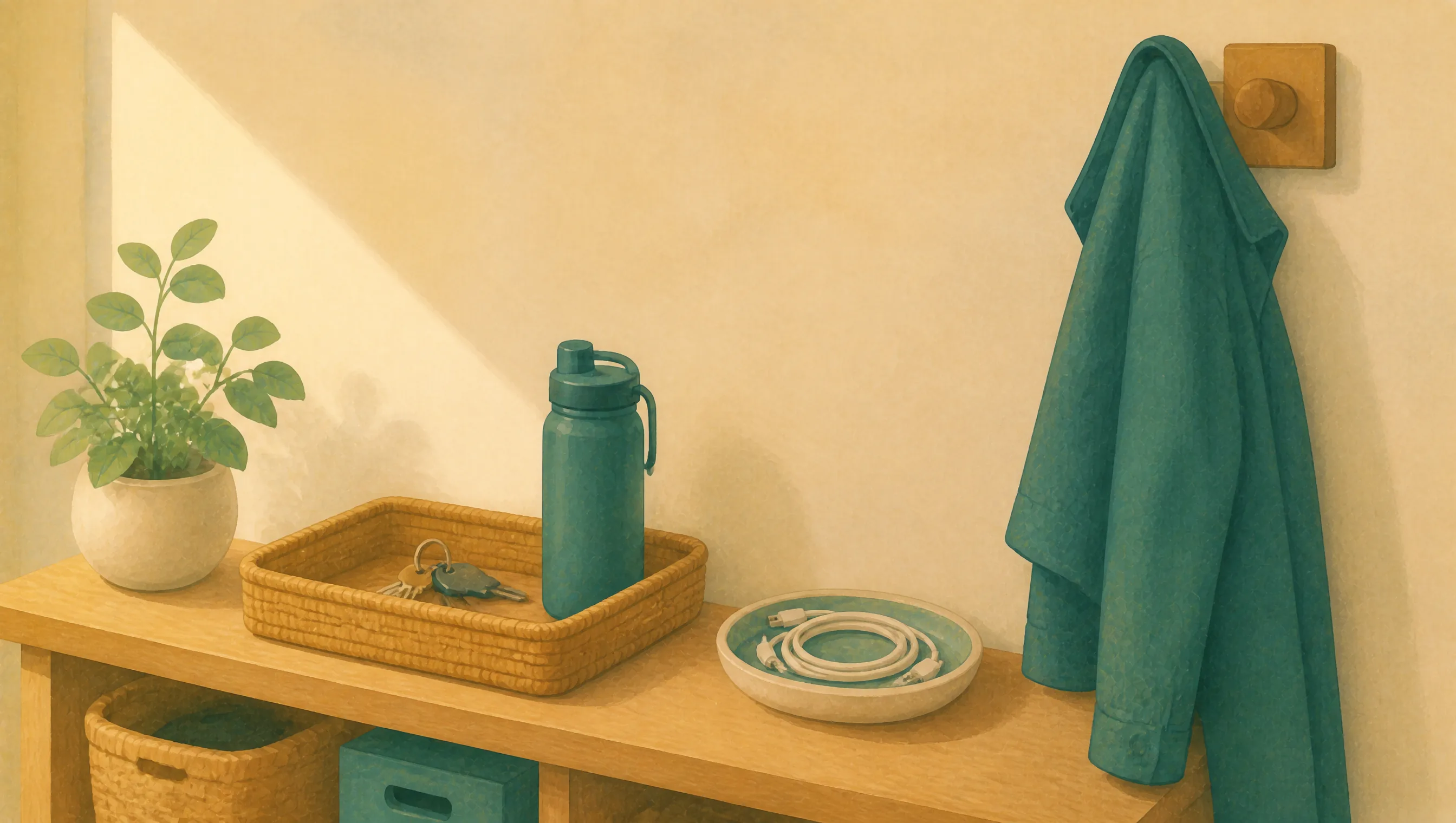
An external brain is not the number of reminders in a house. It is a small system that makes the right information, material or cue available where and when the child can act.
The term is useful shorthand, not a clinical label. It does not mean a child's brain is missing or that a tool cures executive-function difficulty.
Begin with one costly recurring task
Do not organise the whole house over a weekend. Choose one task that creates frequent loss, distress or adult rescue:
- leaving for school with the necessary items;
- taking prescribed medication with adult oversight;
- beginning homework;
- returning dishes from a bedroom;
- preparing for a weekly activity;
- charging a communication device.
Describe the task without blame. “We cannot find the PE kit on Wednesday mornings” is more useful than “Nobody in this house is organised”. Decide what sufficiently finished looks like and when it needs to happen.
Keep the first trial small enough to observe. A successful bag station teaches you more than a beautiful command centre nobody can use.
Map what the task currently asks the child to carry
Walk through the real sequence and mark each hidden job:
- Notice: What signals that the task exists now?
- Start: What is the first physical action?
- Sequence: Which actions follow, and where are decisions needed?
- Materials: What must be found, prepared or moved?
- Time: When must it begin and finish?
- Check: How does the child detect an omission or error?
- Finish: How do they know the task is complete, and what happens next?
Include the adult's hidden work. If a parent reads the school app, remembers PE day, finds the clean kit, opens the bag and asks three times, those are parts of the current system. Removing the parent without relocating those functions does not create independence; it removes infrastructure.
Ask the child where the route breaks. Their answer may differ from yours. “I forget PE” could mean the timetable is not visible, the kit has no home, the smell of the changing room makes the event aversive or they are embarrassed that clothes no longer fit.
Move the least reliable job first
Choose one or two demands to externalise:
- Notice: an agreed alarm, object in a cue position or predictable event;
- Start: the first material already open or placed in hand;
- Sequence: a short list, photograph, card set or audio note;
- Materials: a labelled open container at the point of use;
- Time: a clock action, countdown, calendar event or backward plan;
- Check: a matching list, transparent pouch or photograph of complete contents;
- Finish: a finished pocket, tick, closed container or known handover.
Do not externalise everything because you can. The system needs to be easier to use than the task it supports.
NICE includes environmental modifications in ADHD support and gives examples such as written reinforcement of spoken requests and reducing distractions [1]. NHS guidance suggests one clear instruction at a time and a visible to-do list [2]. Neither source defines an “external brain” system or requires a particular tool.
Give information one trusted home
Families often lose tasks because the same kind of information arrives in several places. A homework instruction may be spoken at collection, posted in an app, photographed by a parent and rewritten on a board. The child does not know which version is current.
Choose a trusted source for each job:
- one calendar for events that affect the child;
- one landing place for items leaving the house;
- one capture point for school actions;
- one current task list, not three partial lists;
- one place for objects with no permanent home yet.
This does not require one app for the entire family. It requires an agreed route. A school message might enter through an adult's email, then become one dated action on the child's board. Decide who performs that transfer and when.
If the adult remains responsible, say so. Invisible responsibility creates blame when the system fails.
Put materials where the action happens
Storage designed for appearance may demand extra remembering and movement. Place everyday objects at their point of use when possible:
- hairbrush and ties beside the mirror used in the morning;
- an open school-item tray near the exit;
- laundry basket where clothes come off;
- charger fixed beside the device's overnight place;
- cleaning cloth where spills are noticed.
The most elegant storage is not necessarily the most accessible. Lids, stacked boxes, tiny labels and items kept out of sight can add steps. Open, visible storage may reduce search but increase visual load. Test the balance for this child and household.
Duplicates can be sensible when the cost and safety allow. Keeping a pen at each homework location is an environmental decision, not cheating.
Make every cue lead somewhere
An alarm that says “homework” alerts the child to a problem. It does not reveal the assignment, materials or first action.
Connect the cue to the route:
At 4.30, go to the table. The open school platform and today's card will be there.
When the programme ends, take the cup in your hand to the kitchen tray.
If a digital notification disappears, make sure the instruction remains retrievable. If the child dismisses alarms automatically, another alarm is unlikely to solve it.
The cue should arrive early enough for the task to happen. A reminder to return a form after the child has left for school records failure rather than supporting action.
Build the child in as a user and designer
Ask the child what they will notice, what they understand and what feels exposing. A visual timetable in the family kitchen may be useful at seven and unacceptable at fifteen. A teenager may prefer a private shared list, phone automation or one message.
Let the child choose from workable options: words or images, board or phone, sound or vibration, open tray or drawer. Ask them to demonstrate how they would find the next action.
Choice does not mean giving a child sole responsibility for health or safety they cannot yet manage. Adults retain appropriate control of medication, dangerous equipment, money or travel while making the supported part transparent.
The Build the External Brain module provides a fuller household method. It uses the same principle: support should be co-produced and adjusted against what happens, not imposed as décor.
Include checking without turning it into surveillance
A useful check helps the child detect whether the task is complete. It need not be a parent inspecting afterwards.
For a bag, the child can match contents to a short list or use a pouch whose empty sections reveal what is missing. For a room, a photograph can show the agreed safe finish. For online work, the submission confirmation may be the finish cue.
Decide which checks remain adult responsibilities. A parent may verify medicine, a payment or a travel plan because the consequence of error is high. Explain the reason and preserve privacy elsewhere.
Organisational skills interventions for children with ADHD have studied multi-component systems involving taught organisation, planning, practice and reinforcement. In one randomised trial, structured organisational approaches improved several parent-rated organisational outcomes compared with a wait-list, although results and measures varied [3]. That does not prove a homemade system or one app will work for every child.
Build a backup for the predictable failure. If the phone is flat, the card is missing or the internet is unavailable, keep the essential next action somewhere simple. The backup should protect medication, travel or another high-impact task, not duplicate every convenience and create a second system to maintain.
Test the system on an ordinary hard day
Run the arrangement for a week without adding new parts each morning. Record:
- Did the child notice the cue?
- Could they find and understand the next action?
- Were materials ready where needed?
- Did adult prompts or rescues reduce?
- Was the task completed accurately enough?
- Did conflict, delay or lost items change?
- Could the family maintain the system when tired?
A system that works only after an adult resets every card, updates every list and points repeatedly is still adult-supported. That may be entirely appropriate. Make the support visible so you can decide whether to keep it, automate it, share it or teach one portion.
Remove failed or duplicate cues. Do not leave abandoned charts on the wall as evidence that the child did not try. Change one variable at a time: location, form, timing, amount of information or adult role.
Define independence accurately
Adults use calendars, satnav, direct debits, shopping lists and other people. Independence does not mean holding every future action in unaided memory.
For a child, progress may be:
- choosing the support that fits the task;
- retrieving a plan without another spoken explanation;
- asking for a check before a costly error;
- setting a cue themselves;
- noticing when a system has stopped working;
- completing more of the task with a stable level of help.
The guide to building daily-living independence with support included carries this principle into adolescence and adulthood.
An external brain should not make the home feel like a workplace dashboard. It should quietly hold the few things that repeatedly fall, so the child has more capacity for the activity and more control over how support reaches them.
Sources and further reading
- [1] NICE. Attention deficit hyperactivity disorder: diagnosis and management. 2018; last reviewed May 2025 (accessed 4 August 2026).
- [2] NHS. ADHD in children and young people. Page last reviewed March 2025 (accessed 4 August 2026).
- [3] Abikoff and colleagues. Remediating organizational functioning in children with ADHD: immediate and long-term effects from a randomized controlled trial. 2013 (accessed 4 August 2026).