
How do I get my child to help with chores without a battle?
How to turn household contribution into a clear, accessible task with a fair finish, visible support and less repeated conflict.
The short answer
Choose one household task whose outcome genuinely helps, and define a finish the child can recognise. Map the hidden work: noticing, stopping another activity, finding materials, sequencing, tolerating sensory input, checking and putting equipment away. Then assign a stable time or event, prepare materials at the point of use and give one cue linked to the first action. Teach the task outside the pressured moment and keep the required contribution proportionate to the child's access and the rest of the family's needs. Choice can cover which task, order or method without pretending the contribution itself is optional. Praise or payment may acknowledge work, but neither makes an inaccessible task accessible. Review the first break point, adult help, conflict and useful completion. A fair contribution can include tools, shared work and an adult check; it does not need to look identical across siblings.
- Choose a task with a real household purpose and a visible sufficient finish.
- Include initiation, materials, sensory access, sequence, checking and clearing away.
- Teach outside the rushed moment and use one retrievable cue.
- Make contribution fair in purpose rather than identical between children.
- Keep rewards separate from food, care, belonging and necessary support.
“Can you help around the house?” sounds reasonable. To a child, it may contain no task, no start, no finish and no answer to what will happen to the activity they are already doing.
Children can make real contributions without chores becoming moral tests. The work is to define the job, make access possible and share responsibility fairly.
Choose a useful task, not a character lesson
Start with one recurring job that genuinely helps the household:
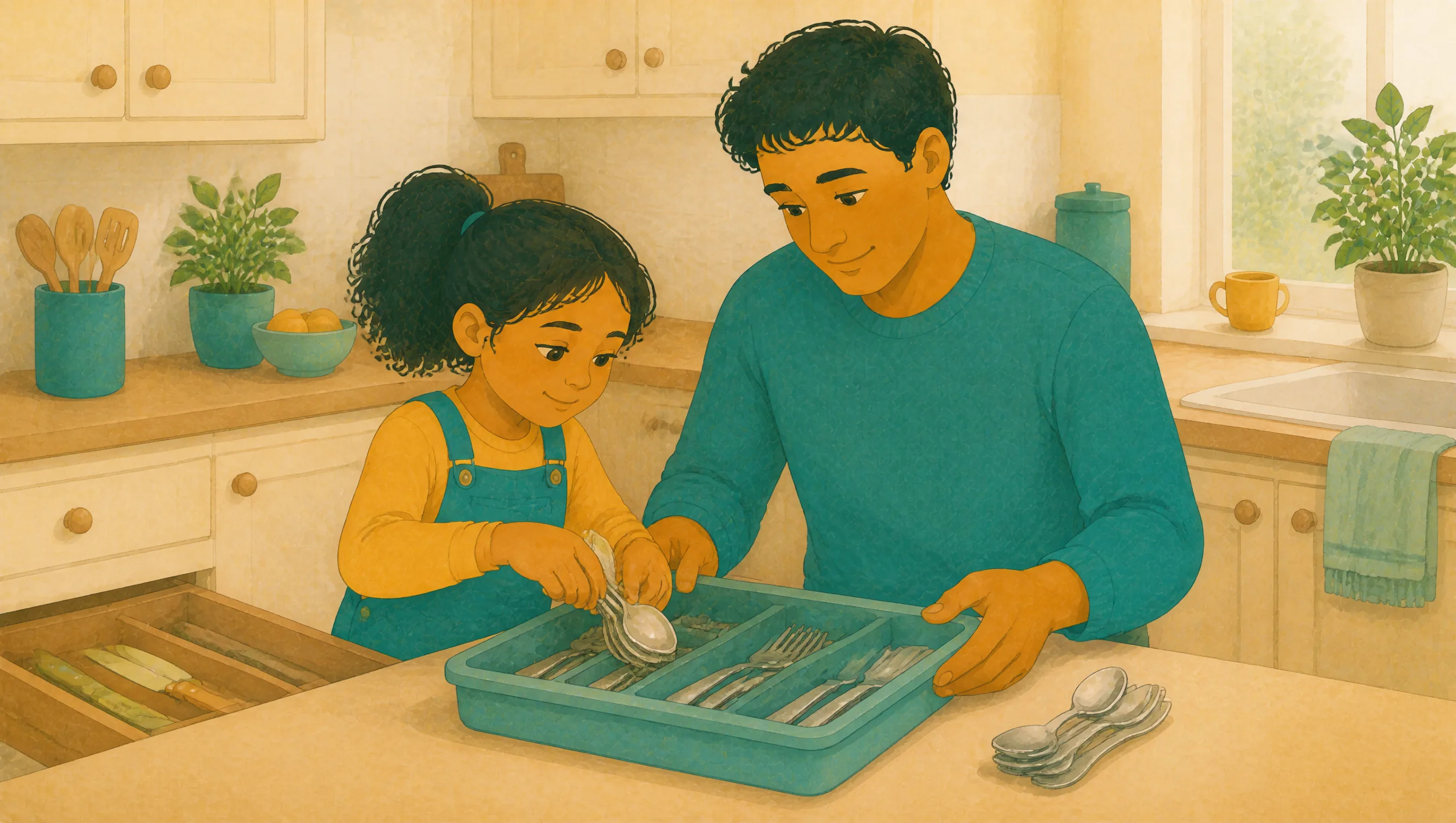
- place clean cutlery in three sections;
- carry used cups to a kitchen tray;
- pair socks from one basket;
- refill the pet's water with adult supervision;
- wipe the table after a meal;
- put recycling into the correct indoor container;
- place their worn clothes in a reachable basket.
Avoid inventing work merely to teach responsibility. A task has clearer meaning when somebody needs its outcome.
Consider the child's age, access, health and total demands. Contribution does not have to be identical to a sibling's. Fairness may mean similar useful effort with different tasks and support.
Define sufficient finish
“Tidy the kitchen” is a category. “Put the clean cutlery from this tray into these three drawer sections” is a task.
Write what counts as enough:
- which items;
- which area;
- how much;
- what quality or safety check applies;
- where equipment goes afterward;
- what happens next.
Do not allow the finish to expand while the child is working. If they complete the agreed table and an adult adds the worktop, the original agreement stops being trustworthy.
The guide to turning a chore into observable steps helps with larger jobs.
Map the hidden demands
A chore may require the child to notice a cue, stop a preferred activity, hold instructions, find materials, tolerate smells or wet textures, sequence actions, judge cleanliness, manage time and recognise completion.
Observe where the route first breaks.
For laundry, the difficulty might be touching damp fabric, distinguishing settings, carrying a heavy basket or remembering that the machine finished. For a bedroom, it may be deciding where mixed objects belong rather than unwillingness to improve the room.
Change the relevant part: gloves, a lighter container, labelled sections, a prepared cloth, a photograph of sufficient finish or an adult handling chemicals. Do not use repeated reminders to solve an inaccessible material or sensory demand.
Attach the chore to a stable event
“Later” requires somebody to remember and initiate. Use a reliable event:
- after the evening meal, cup to tray;
- when the delivery arrives, cardboard to the indoor recycling point;
- Saturday after breakfast, towels into the washer with an adult;
- before the pet's evening food, refill water.
Keep the frequency proportionate. A daily task may be easier to remember but harder to sustain. A weekly task may need a calendar cue.
NICE advises clear, appropriate rules and structure in the day for children with ADHD, alongside individual environmental modifications [1]. This does not prescribe chores or show that one schedule works for every family.
Give one cue and one first action
“How many times do I have to ask?” describes the adult's experience but adds no route.
Agree the cue beforehand:
When dinner plates reach the counter, your first action is to bring the cutlery tray to the drawer.
If the child does not begin, check access. Did they notice? Is the first action clear? Are materials ready? Are they still expected to close another activity?
NHS ADHD guidance suggests clear, simple instructions one at a time and a visible to-do list where helpful [2]. A list is useful only if the child can find, understand and act on it.
Use the initiation guide to make the first action easier when the task is understood but the start repeatedly fails.
Teach outside the pressured moment
Demonstrate the sequence when nobody is waiting for guests. Work side by side and name the decision points.
For wiping a table:
- adult removes hot or sharp items;
- child gets the prepared damp cloth;
- move items to the safe side;
- wipe from one marked edge to the other;
- check against the agreed photograph;
- cloth goes in the laundry container.
Prompt only the part that needs support. Let the child repeat the action rather than listening to a long explanation. If hand strength, coordination or understanding makes the method inaccessible, adapt it.
Practice does not need to be disguised as fun. It does need a manageable size and enough help for useful completion.
Decide what is shared and what is owned
A child can contribute to a task without owning the whole chain. They may load safe items while an adult handles knives, detergent and machine settings. They may collect rubbish while an adult decides what can be discarded.
Make adult work visible. “You empty these three bins; I tie and take out the bag” prevents the adult from later claiming they did everything or the child from being blamed for a step never assigned.
For the wider question, use the guide to which support should remain.
Offer bounded choice
If household contribution is expected, do not pretend that “Do you want to help?” is open when no is unacceptable.
Try:
The table and pet water both need doing. Which one will you take?
Your laundry contribution is fixed. You can fold at the table or on the floor.
Choice can cover task, order, method, music, tools or working alone versus beside someone. Keep the available options genuine.
A child may communicate that a task is painful, disgusting, confusing or frightening. A fixed expectation to contribute does not require ignoring that information. Find another route or task.
Use acknowledgement and rewards carefully
Specific acknowledgement connects effort to its effect:
You emptied the tray, so the drawer is ready for breakfast.
Payment can be appropriate when the household treats the task as paid extra work. Ordinary contribution and paid work should be distinguishable. Agree the rate and finish in advance.
A reward chart may provide immediate feedback for a narrow, accessible behaviour, but it cannot supply missing skill, safe materials or a clear endpoint. The article on whether a reward chart fits keeps those boundaries explicit.
Never make meals, comfort, communication devices, affection, ordinary access to belongings or necessary support contingent on chores.
Respond to refusal with information, not surrender or escalation
First check whether the demand was clear, expected and possible. Restate the fixed part and offer the agreed support.
The cups still need to reach the tray. I can carry them with you or you can use the basket.
If the child is overwhelmed, ill or exhausted, use the hard-day contribution: a smaller portion, shared task or adult takeover that is named as support. Return later to the system rather than conducting a character hearing.
If one task repeatedly creates distress, change the task. Equal contribution does not require prolonged exposure to a specific aversive sensation when useful alternatives exist.
Keep the family comparison honest
Research involving 67 children aged 6 to 14 with ADHD examined associations between symptoms, household-task performance and caregiver assistance [3]. It was observational and did not identify a chore system that treats ADHD. It does support looking at task characteristics and help rather than assuming household participation is a simple measure of motivation.
Include the adults' capacity. A chore system that takes forty minutes of supervision to save five minutes of work may be a temporary teaching choice, but it is not yet a household solution. Keep, simplify or change it deliberately.
Choose tasks that are safe to get partly wrong
Early practice works best when an error is visible and recoverable. Pairing socks, moving unbreakable dishes or refilling an indoor container allows the adult to help without a serious consequence.
Keep chemicals, hot surfaces, sharp tools, medication, heavy lifting and unsafe outdoor access under appropriate adult control. A child who can recite safety rules may still need supervision to notice and apply them during a multi-step task.
Do not teach through avoidable damage or humiliation. If the child loads the dishwasher differently, check whether the result is safe and clean before correcting it to match adult preference. Reserve exact methods for steps where method affects safety or outcome.
Adapt when capacity changes
School pressure, illness, poor sleep, pain or a changed timetable can make an established contribution temporarily inaccessible. Use a hard-day version: half the basket, working beside an adult or swapping to a simpler useful task.
This should not become an unspoken cancellation that leaves another person resentful. Name the change and who is carrying the remaining work. Restore the ordinary route when it is accessible, or redesign it if the pattern continues.
If a child suddenly loses several daily skills or a task becomes painful or frightening, investigate rather than increasing consequences.
Make the system travel between carers
Different homes do not need identical chore lists. Agree the principle that the child contributes to each household through a task they can access, and that adult safety responsibility remains clear.
Avoid sending the child between adults with accusations that one home expects too little. If a task needs continuity, such as managing school clothes, use an adult handover that states what is clean, where it is and who completes the next step.
A grandparent or childminder should know the sufficient finish and support, not be expected to infer them from “They know what to do”. The child's successful performance in one setting may depend on materials, timing and prompts that are absent in another.
Review the contribution after two weeks
Ask:
- Was the cue noticed?
- Could the child enter the first action?
- Were materials and sensory conditions accessible?
- Was sufficient finish stable?
- What adult help remained?
- Did the result genuinely help the household?
- Did prompts and conflict change?
- Was the arrangement fair and maintainable?
Increase responsibility one function at a time. The goal is not a child who performs domestic work without preference or support. It is a family in which contribution is real, expectations are understandable and nobody has to turn a missed spoon into a verdict on character.
Sources and further reading
- [1] NICE. Attention deficit hyperactivity disorder: diagnosis and management. 2018; last reviewed May 2025 (accessed 4 August 2026).
- [2] NHS. ADHD in children and young people. Page last reviewed March 2025 (accessed 4 August 2026).
- [3] Mendes and colleagues. Household task demands for quiet and focused behavior facilitate performance by ADHD youth. 2016 (accessed 4 August 2026).