
What do I do when my child is left out or falls out with a friend?
Help your child understand what happened, decide whether repair is wanted and recognise when exclusion has become a pattern adults must address.
The short answer
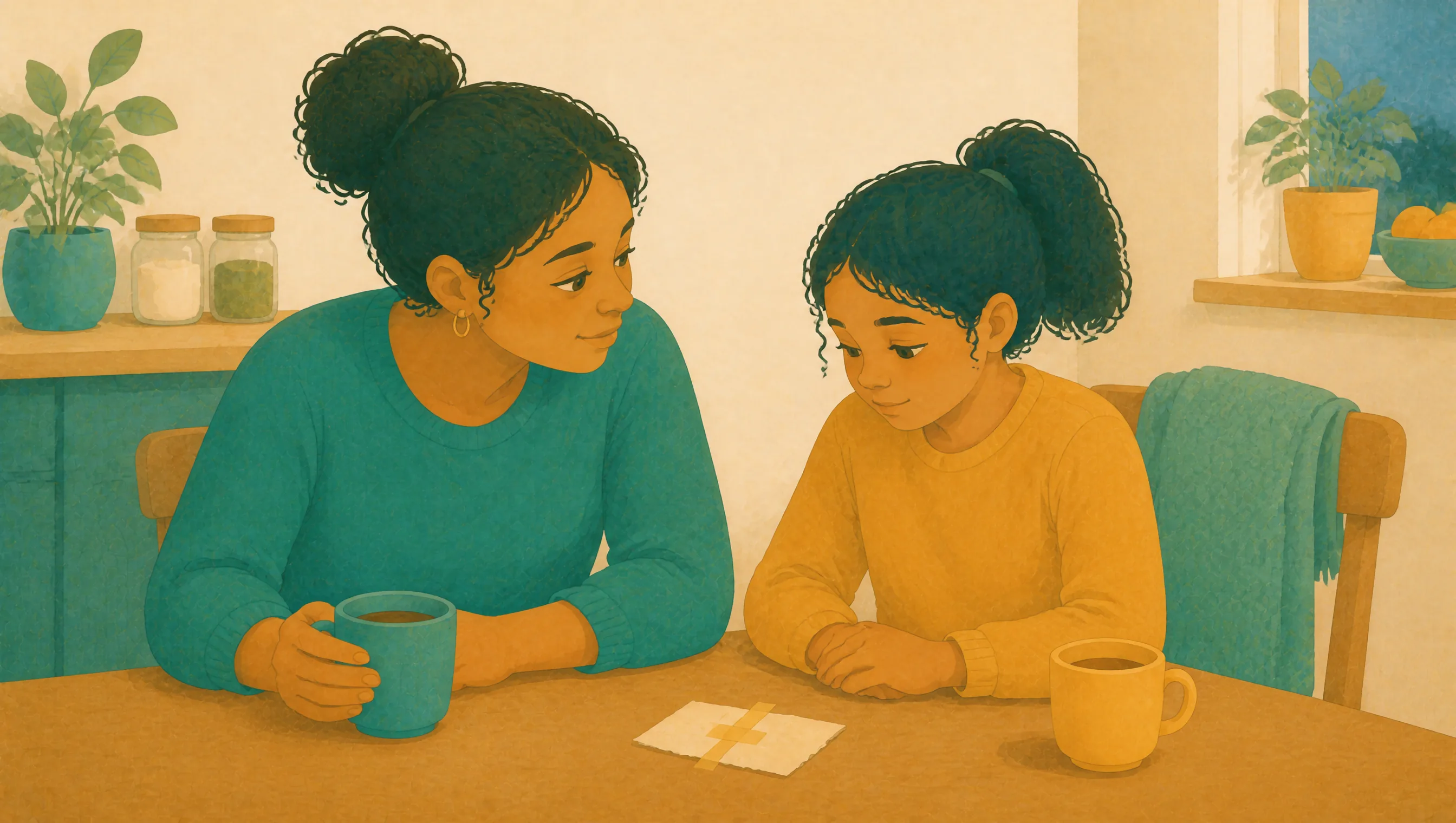
Begin with the impact, not an instant verdict: 'That hurt. I want to understand what happened.' Let the child tell you now, later, in writing or with a timeline. Separate facts from interpretations and identify whether this was a single exclusion, a misunderstanding, a conflict in which both children had influence, or repeated targeted harm involving a power imbalance. For an ordinary rupture, ask whether your child wants clarification, a repair message, space or an ending. Help them say the specific impact and request without writing the whole relationship for them. Do not push reconciliation when the other child ignores no, demands secrecy, humiliates or repeatedly excludes them. Record patterns, save relevant messages and involve school or the responsible adult. Friendship can end without either child being bad; bullying and coercion require protection, not better social performance from the child being harmed.
- Validate the hurt before deciding what the event means.
- Reconstruct facts, meanings and missing information without forcing an immediate account.
- Match the response to exclusion, misunderstanding, ordinary conflict, coercion or bullying.
- Offer repair as a choice, not an obligation to resume the friendship.
- Involve adults when harm is repeated, targeted, unsafe or shaped by a power imbalance.
Being left out can hurt even when it happens once. A friendship ending can feel like losing the structure of the school day, a shared interest and the one person who made a place manageable. The child may need comfort before they need analysis.
Begin with:
"That hurt. I want to understand what happened."
Avoid promising that the friendship can be fixed or deciding immediately that the other child is a bully. The first task is to give your child a reliable adult and enough space to build an accurate account.
Let the account arrive in the form it can
A distressed child may tell the story out of order, repeat one detail or say "everyone hates me". Do not cross-examine them while they are trying to recover.
Offer options:
- tell me now;
- write or message it;
- draw where people were;
- show me the conversation;
- start with the worst part; or
- pause and return tomorrow.
Reflect the impact without confirming details you do not yet know:
"You expected to sit with them, and they moved away. You felt humiliated."
This is different from "They planned to humiliate you". Keep intention open until there is evidence.
YoungMinds distinguishes being alone from feeling lonely and recognises that a young person can feel isolated even among other people.1 Take the child's experience seriously even if adults have seen them talking to classmates.
Separate four different situations
The same sentence, "They left me out", can describe different problems.
A single exclusion
The group may have chosen a limited activity, made a thoughtless decision or failed to notice the child trying to join. The impact can be real without a repeated pattern.
A misunderstanding
One child may have heard "not now" as "never", missed a changed plan or interpreted silence differently. Both people may need clearer information.
An ordinary friendship conflict
Friends can disagree, say something unkind, want different things or need space. Both may have influence, and repair may be possible if each can speak and set boundaries.
Bullying or coercion
The Anti-Bullying Alliance defines bullying as intentional, repeated hurt within a relationship involving an imbalance of power.2 Power can come from group size, popularity, age, information, social confidence or access to something the child values. Online and offline behaviour can combine.
Not every harmful event fits the bullying definition. A one-off assault, threat or sexual incident can still require urgent adult action. Do not wait for repetition where safety is already at stake.
Reconstruct without teaching mind-reading
When the child is ready, make a simple record:
- What happened that can be observed?
- What exact words or messages were used?
- What did your child think they meant?
- What might the other person have meant?
- What happened before and afterwards?
- Was this similar to an earlier event?
Use "might" until meaning has been checked. The child should not be taught to replace uncertainty with a confident negative explanation or a confident reassuring one.
If the difficulty centred on hidden meaning, use the guide to reconstruct a communication misunderstanding. Ask the other child or responsible adult for information when that is appropriate.
Screenshots can preserve the order of an online exchange, but read enough context to understand it. Do not circulate private messages widely or demand unrestricted access to every conversation as the price of help.
Ask what the child wants now
Adults often assume the goal is reconciliation. Your child may want an explanation, an apology, a boundary, a pause, a different seat or an end to the friendship.
Ask:
- Do you want to know what they meant?
- Do you want them to understand the impact?
- Would you like space before any contact?
- Is there something you want an adult to stop?
- Do you want this friendship to continue?
The answer may change after rest. Do not send a message from the child's account while emotions are high unless there is an immediate safety reason and you have explained what you are doing.
Help with a specific repair
For an ordinary misunderstanding or conflict, repair works better when it names the event rather than making a judgement about the whole person.
Clarification:
"When you said there was no room, did you mean today or that I cannot join anymore?"
Impact and request:
"When the group changed without telling me, I waited in the wrong place. Please message me if the plan changes."
Ownership:
"I shouted when you changed the rule. That frightened you. I am sorry I shouted. Next time I will pause the game and ask which rule we are using."
A valid apology names the child's action and its impact. Do not require them to accept blame for being excluded in order to earn contact again.
The other child also has a choice. A repair message can be sincere without guaranteeing that the friendship resumes.
Know when not to push repair
Do not coach your child back into a relationship where the other person:
- repeatedly humiliates or excludes them;
- ignores no or punishes boundaries;
- demands secrecy, possessions, money, images or rule-breaking;
- threatens to withdraw the friendship to obtain compliance;
- shares private information to control them; or
- recruits a group to target them.
These patterns need adult protection and, where relevant, safeguarding or police routes. Better scripts from the child being harmed do not correct an abusive use of power.
Also respect an ordinary ending. Children can stop being compatible without either becoming the villain. Help your child grieve the loss and rebuild access to people and places rather than requiring one relationship to survive indefinitely.
If your child caused harm
Listening without blame does not require denying your child's part. They may have shared a private message, shouted, excluded somebody in return or continued after the other child said stop. Describe the action and impact without turning it into an identity:
"You posted the screenshot after she asked you not to. That exposed a private conversation to the group. We need to stop it spreading and take responsibility for that action."
Ask what can be repaired and what protection the other child needs. This may mean deleting a post where possible, asking recipients not to forward it, informing an adult, replacing damaged property or giving the other child space. An apology should be specific and should not demand forgiveness:
"I shared your message without permission. That was wrong. I have deleted my copy and told the group not to forward it. You do not have to reply."
Keep investigating what contributed, including impulsivity, unclear group rules or a misunderstanding. Explanation helps prevent repetition; it does not transfer responsibility to the person harmed. If the behaviour is serious, repeated or unsafe, involve the responsible adults rather than managing it as a private friendship lesson.
Involve school with specific information
If the event happened at school, ask for observation and action, not a general request to "keep an eye". Write:
- dates, places and people involved;
- exact words or actions reported;
- witnesses or screenshots;
- earlier related events;
- impact on attendance, learning, breaks or safety;
- what your child is asking for; and
- the immediate protection or clarification needed.
Ask who will speak to the child, how they can report without doing so publicly, what happens during break and when you will review the response.
School duties and procedures differ across the UK. GOV.UK's school-bullying law page describes the England position and notes that some forms of bullying may also be illegal.3 Families elsewhere should use their nation's guidance and the school's current policy. In any nation, immediate danger requires 999.
Do not accept a solution that removes the targeted child from every shared space while leaving the harmful pattern untouched. A temporary safe place may be needed, but the longer plan should preserve access and accountability.
Help the child regain a wider foothold
After a friendship rupture, the child may feel that every part of school belongs to the former friend. Identify one reliable adult, one manageable place and one activity not controlled by that relationship.
Do not immediately arrange a replacement best friend. Use the principles for supporting friendship without taking over: accessible opportunities, shared interest and room for mutual choice.
At home, protect recovery and ordinary identity. The child is more than the friendship event. Continue activities that provide competence, enjoyment and contact without making every conversation about social repair.
Watch the impact over time
Seek additional support if the child remains persistently low or anxious, stops attending, cannot sleep or eat as usual, withdraws from valued activities or talks about harming themselves. Friendship loss can be significant; it should not be minimised as school drama.
If your child says they do not want to be alive, talks about hurting themselves or you think anyone is in immediate danger, stay with them and use the appropriate urgent route. Call 999 or go to A&E in an emergency.
The aim is not to prevent every rejection. It is to give the child a way to understand what happened, make a choice about repair and know that adults will act when the problem is larger than a friendship misunderstanding.
Footnotes
-
YoungMinds offers young-person guidance on loneliness, isolation and feeling misunderstood. It supports taking the experience seriously rather than diagnosing the cause. ↩
-
The Anti-Bullying Alliance definition uses hurt, repetition, intention and power imbalance. Individual incidents still require assessment and may need action even when not all features are established. ↩
-
GOV.UK describes school and legal routes in England. Education procedures differ across the UK, so the article does not present it as UK-wide law. ↩
Sources and further reading
- [1] YoungMinds. Alone, lonely or misunderstood. Current young-person guidance (accessed 4 August 2026).
- [2] Anti-Bullying Alliance. Our definition of bullying. Current professional guidance (accessed 4 August 2026).
- [3] GOV.UK. Bullying at school - the law. Current England guidance (accessed 4 August 2026).