
Why does my child wake in the night, and what should I do?
A practical night-waking plan that checks comfort, health, breathing, patterns and support before assuming the child has learned a bad habit.
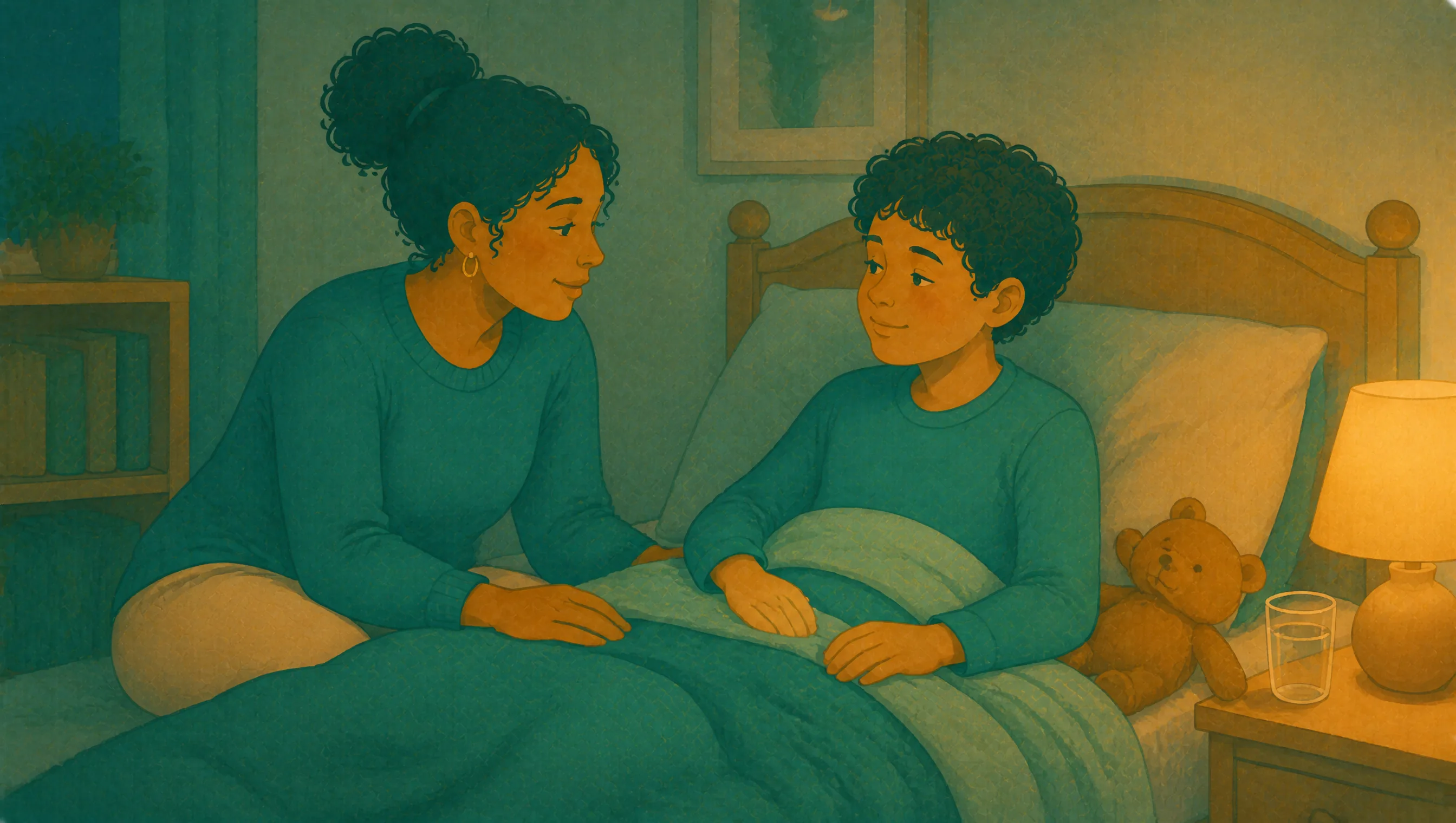
The short answer
Brief waking can occur between sleep periods, but repeated, prolonged or distressing waking needs a closer look. Record when the child wakes, how alert or distressed they are, what they do, the support required and when sleep returns. Check pain, reflux, constipation, itching, temperature, hunger, toileting, anxiety, nightmares, medication, sound, light, restless movement and breathing. Keep the overnight response quiet, predictable and sufficient for safety and comfort: use few words, meet the identified need and return to the same settling cue. Do not withhold necessary care to avoid creating a habit, and do not add several new rules at 2am. Speak to the GP when waking is persistent, has changed suddenly or significantly affects the child or family. Loud habitual snoring, choking, breathing pauses, significant pain, unusual episodes or marked daytime sleepiness need prompt clinical attention.
- Record what happens before, during and after waking rather than guessing motive.
- Check discomfort, breathing, medication, anxiety and environment.
- Make the overnight response calm, brief and predictable, but still meet genuine needs.
- Change one safe factor at a time and judge the whole night and following day.
- Persistent or concerning waking deserves medical assessment.
Night waking can mean a child calls once and settles with a drink. It can also mean hours of movement, distress, conversation or supervision while the household stops functioning. Those are not the same problem.
The first task is not to prevent every waking. It is to understand what happens, meet immediate needs safely and make the route back towards sleep as clear as possible.
Describe the waking precisely
For about two weeks, record:
- the time the child went to bed and probably fell asleep;
- when they woke and how often;
- whether they seemed sleepy, alert, frightened, confused or in pain;
- what they said or did;
- breathing, snoring, sweating or unusual movement;
- toilet, hunger, thirst, temperature or discomfort;
- the support given;
- when sleep returned;
- final waking and daytime alertness.
Use estimates. Do not stay awake staring at the clock for perfect data. “Around 1.30am, crying and scratching both arms; eczema cream applied; settled by 2” is useful. “Bad night again” is difficult to act on.
Notice whether waking happens at a similar time, after a particular household sound, when medication changes, before a demanding school day or only in one room. A pattern suggests what to investigate; it does not prove cause.
Also distinguish a child who is fully awake from one who appears only partly awake. A child may speak, cry or move while confused and have little memory later. Do not force a detailed conversation or assume they are deliberately ignoring you. Keep them safe, note what you observe and seek clinical advice about recurrent or concerning episodes.
Check the body before the behaviour
At night, a child may not be able to explain pain or internal sensations. Check for:
- fever or signs of illness;
- reflux, coughing or discomfort when lying down;
- constipation, diarrhoea or needing the toilet;
- toothache, earache or growing pain;
- itching, skin irritation or damp clothing;
- hunger or thirst that fits the day’s intake;
- uncomfortable legs or repeated movement;
- side effects or changes in prescribed medication;
- menstrual pain where relevant.
Look at what the child’s body is doing. Curling tightly, holding the face, swallowing repeatedly, scratching or becoming distressed when lying flat may communicate more than a question at 2am. Notice body signals the child may not be able to name.
Do not repeatedly treat unexplained pain at home without advice. Record it and speak to the GP.
Pay attention to breathing and unusual events
Loud habitual snoring, choking, gasping or apparent breathing pauses are not ordinary “restless sleep”. NICE advises specialist assessment for obstructive sleep apnoea when those signs occur in an autistic child or young person.1 Report the observations for any child.
Also seek advice about unusual episodes: repeated rhythmic movement, prolonged confusion, stiffening, loss of awareness, injury or events that look different from the child’s normal sleep behaviour. If safe, note duration and what you observed before and after. A clinician may ask for more information; do not place the child at risk to obtain a recording.
Paediatric sleep studies can monitor sleep alongside breathing, heart rate, oxygen and carbon dioxide when a clinical team considers one appropriate.2 A parent cannot determine the need for a study from an online checklist.
Check the room at the time of waking
The bedroom at 2am may differ from bedtime. Heating switches off. Traffic begins. A sibling returns. The duvet has moved. A security light reaches the window. The child wakes cold, disorientated or unable to recreate the conditions in which they fell asleep.
Check light, sound, temperature, bedding, smell and body position. If your child fell asleep with an adult, moving sound or particular light that is absent later, record that without blame. The solution may be to make a safe cue sustainable through the night, or gradually change it when the child has capacity.
Check sensory barriers in the room and bed one variable at a time. Avoid buying a complete sleep environment before identifying the barrier.
Prepare a low-thinking overnight response
Decide the basic sequence in daylight. For example:
- check immediate safety and physical need;
- use the toilet or offer the agreed drink if needed;
- keep light low enough for safe movement;
- use one brief reassurance;
- return to the familiar resting place and cue;
- postpone non-urgent discussion until morning.
Use few words: “You are safe. Toilet, drink or back to bed?” A child who needs language may prefer a small bedside card. Another may need an adult to sit quietly. Necessary support is not a moral failure.
Keep the response uninteresting where possible, but do not confuse “uninteresting” with cold or withholding. Comfort, pain relief used as clinically directed, toileting, communication and safety still matter. The aim is not to make help unpleasant enough that the child stops asking.
Match the response to the child's state. A frightened child may need brief orientation: who is there, where they are and what happens next. A child who is awake but calm may need fewer words and a familiar cue. Someone who is in pain or unwell needs care, not a behavioural response. If you cannot tell, begin with safety and the body rather than a warning.
Nightmares can leave a child alert and seeking reassurance. Avoid an interrogation in the dark. Acknowledge the fear, orient them to the present room and agree to talk more in daylight if they want. If distressing dreams are frequent, linked to trauma or substantially affecting life, include them in the GP or mental-health conversation.
Prevent 2am from becoming decision time
Prepare what can safely be prepared: water, a change of clothing, suitable skin care, a dim light, a visual card or the agreed comfort item. Keep medicines secured and follow their directions; do not leave doses for a child to choose overnight unless a clinician has explicitly arranged this.
Agree which adult responds and how adults hand over if sleep deprivation is affecting safety. If one carer must drive early, work a hazardous job or supervise another vulnerable child, include that in the plan. Family capacity is part of the sleep problem, not an embarrassing footnote.
Write a one-line handover when adults share nights: waking times, medicine given as directed, concerning symptoms and what helped. This prevents an exhausted second adult repeating a dose, restarting a debate or missing a pattern. Keep the record somewhere secure but accessible to the adults responsible.
For a child who walks around, make the route to the toilet safe, secure external doors appropriately and reduce obvious hazards without locking them into a room or restricting emergency escape. Seek professional advice if night-time wandering creates significant risk.
Change one maintaining factor at a time
A repeated adult action may become part of returning to sleep. That observation does not prove manipulation. The child may genuinely be unable to recreate sleep without it.
If you want to change a support, choose a small step that preserves safety: sit beside rather than on the bed, use the same short phrase, reduce conversation, or move gradually towards the doorway. Do not withdraw all support on the same night that you change the bedroom and bedtime.
Judge the result across several comparable nights. Measure distress, time awake, support required and next-day functioning. A child who becomes silent while remaining awake and frightened has not necessarily improved.
If a step increases distress sharply, restore the last workable level of support and reconsider it in daylight. Gradual change is not a contest of endurance. Some children will need an adult's presence for longer because of development, disability, illness or anxiety; the plan should make that support sustainable rather than pretending it is absent.
Review the whole sleep schedule
Night waking can be affected by naps, too much time in bed, a very early bedtime, an inconsistent schedule or a sleep period that is shifted later. It can also persist despite a sensible routine because discomfort, breathing, anxiety or another sleep problem remains.
NICE recommends that sleep assessment for autistic children includes the exact problem, day-and-night pattern, environment, physical discomfort, medication, activity and family impact, supported by a two-week sleep record.1 That broad view is more useful than assuming every waking has one cause.
If the child is awake and ready for the day at a consistent early time, make a plan for very early waking. If they cannot fall asleep initially, map the whole sleep problem.
Take persistent waking to the GP
Ask for help when waking is frequent, prolonged, distressing, newly changed or substantially affects health and family life. Bring the record, medication information and what you have tested.
Say what you need help distinguishing: pain, breathing, medication effect, anxiety, a movement or sleep disorder, or a pattern that needs a structured sleep plan. If a home change helps, keep the health observations visible rather than assuming the case is closed.
Include the child's account and the care you provide. “Settles within ten minutes” means something different if an adult must remain awake beside them six times each night. The outcome should account for the child's comfort, the amount of waking, the support required and whether anyone can function safely the next day.
At night, use the smallest calm response that meets the real need. In daylight, investigate the pattern properly. That combination protects the child from blame and the family from repeating increasingly complicated experiments in the dark.
Footnotes
-
NICE CG170 recommends a broad assessment of sleep difficulties in autistic children and young people and referral for signs suggesting obstructive sleep apnoea. ↩ ↩2
-
Royal Brompton and Harefield hospitals explain that paediatric sleep studies may monitor sleep, breathing, heart rate, oxygen and carbon dioxide when clinically indicated. ↩
Sources and further reading
- [1] NICE. Autism spectrum disorder in under 19s: support and management. 2013; last updated June 2021; reviewed September 2025 (accessed 4 August 2026).
- [2] NHS. Sleep and young children. Current online guidance (accessed 4 August 2026).
- [3] Royal Brompton and Harefield hospitals. Sleep study for children. Current NHS hospital guidance (accessed 4 August 2026).