
FamilyFX: The Family Reset System

Why is my child's bedroom and school bag always chaos?

How to reduce search, sorting and reset demands in a teenager’s room and school bag without turning organisation into a character judgement.
By FamilyFXWritten February 2026Published 6 August 2026Last reviewed 2 July 2026Next review due 2 July 20278 min readReviewed by FamilyFX
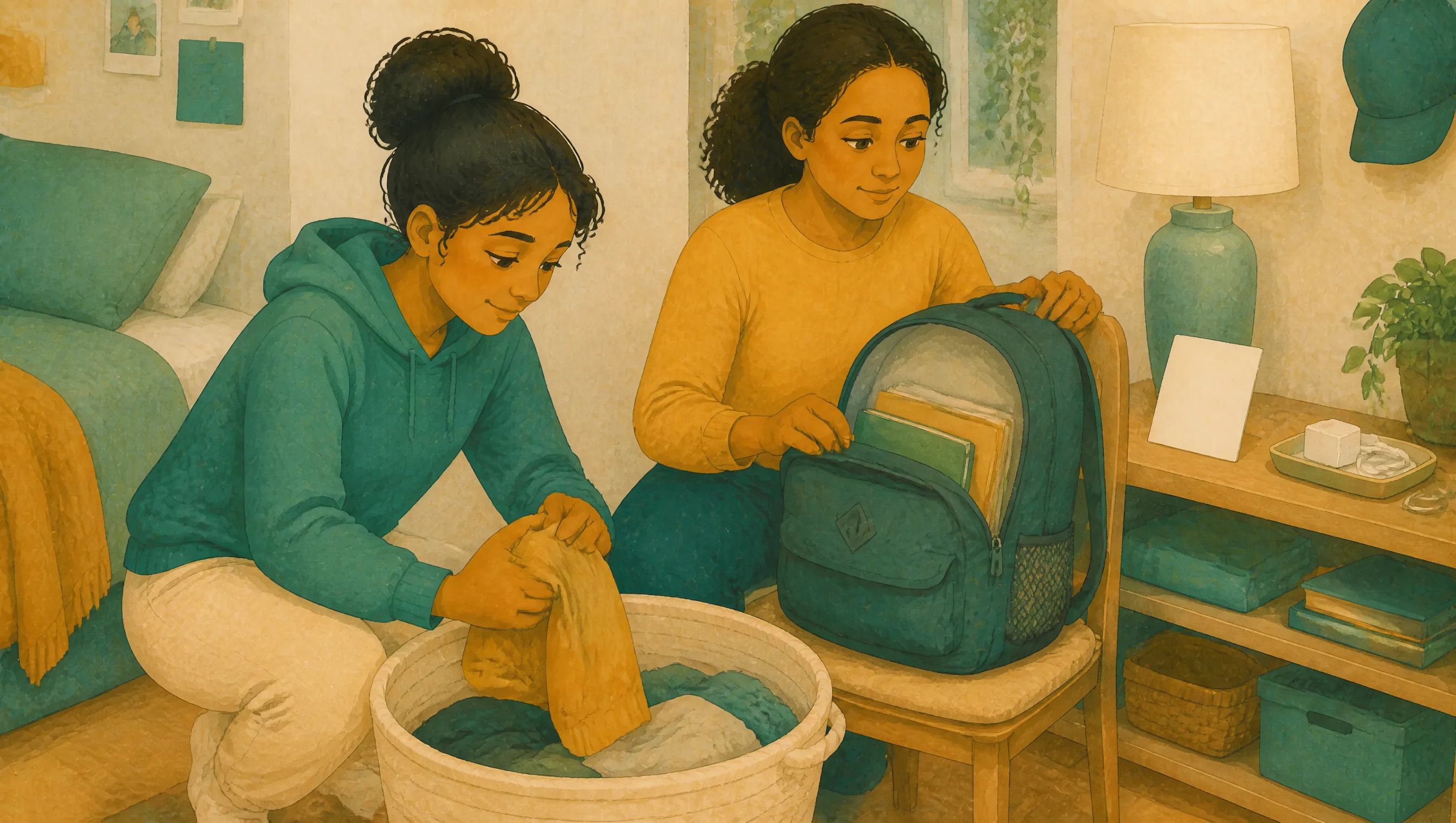
A girl and a woman kneel in a bedroom, one sorting clothes into a wicker laundry basket, the other packing books into a teal backpack on a chair.

The short answer

A room and bag are working systems, not tests of character. They become chaotic when objects have no usable home, storage adds too many actions, school information arrives through several routes, reset points are missing, or the young person cannot see what sufficiently organised means. Begin with function: safety, hygiene, finding essentials and protecting school access. Map where items are used and dropped, create a few broad open categories, and put the school-bag check beside the timetable and bag. Use a holding place for undecided objects. Agree privacy and which standards belong to shared space. Reset one zone at a predictable time with the level of adult help made explicit. Review lost items, search time, lateness and conflict rather than expecting a display-home finish.

  • Organisation should protect access, safety and retrieval rather than enforce an aesthetic ideal.
  • Storage that adds lids, distance, fine sorting or hidden labels may be harder than leaving an object out.
  • Create broad usable homes based on where items are used and naturally dropped.
  • Link the bag check to one trusted timetable or task source and a predictable reset point.
  • Preserve a teenager's privacy while setting clear hygiene, safety and shared-space boundaries.
  • Count adult preparation and checking as support rather than calling the result independent.

A teenager can find the exact cable beneath a mound of clothes, yet cannot locate tomorrow's worksheet. A parent sees disorder; the teenager sees a rough map that works until somebody tidies it. Both can be right. The system may preserve some location memory while failing hygiene, safety and school access.

The aim is not to settle whether the room looks messy enough to matter. Decide which functions need protecting, then reduce the work required to protect them.

Define organisation by what it must do

For a bedroom, the functional minimum might be:

  • a clear route to the door and bed;
  • no food, mould or unsafe rubbish accumulating;
  • clean and dirty clothes distinguishable;
  • medication or dangerous items stored under appropriate adult control;
  • school and communication equipment retrievable;
  • access to sleep, privacy and necessary sensory comfort.

For a school bag, it might be:

  • the correct materials arrive;
  • completed work can be submitted;
  • food and drink remain safe;
  • letters and forms reach the right adult;
  • heavy or unnecessary items do not accumulate;
  • the child can find essentials without emptying everything publicly.

Add family preferences only after these needs are clear. A folded-clothes standard may matter less than clean clothes being available. A teenager's collections can remain visible if exits and hygiene are protected.

See the hidden actions in “put it away”

Putting one item away can require recognising its category, remembering a location, opening a container, moving other objects, tolerating a sensory feature and returning to the original task. If the object has no agreed home, it also requires inventing one.

Storage systems often add friction:

  • lids and stacked boxes;
  • drawers far from where items are used;
  • labels that are too small or abstract;
  • detailed categories that require repeated decisions;
  • hangers for every garment;
  • opaque containers that remove objects from view;
  • an ideal layout that depends on daily adult-level resetting.

Watch where items naturally land. That spot contains information. Put a laundry basket where clothes come off, a tray where school papers appear and a charger where the device rests. Open storage can reduce actions; closed storage can reduce visual load. Choose according to the person and object.

Create broad homes before fine categories

Begin with a few categories that matter to retrieval:

  • wear again;
  • laundry;
  • school;
  • technology;
  • personal projects;
  • rubbish and recycling;
  • undecided.

An “undecided” tray prevents every unusual object becoming a new organisational project. Give it a size limit and a predictable review. It is a buffer, not a place where belongings silently disappear.

Use labels the teenager chooses and can understand. A photograph may help with the expected contents of one school drawer; plain words may be more respectful and efficient elsewhere.

Do not empty the room and install a complete system without the young person. You may remove hazards or perishable food, but an unagreed reset can destroy their location cues and trust. Explain any necessary action and preserve privacy.

Give the bag one route from school information to objects

A school bag cannot be organised reliably if requirements are scattered across a platform, email, spoken instruction, photo and loose sheet.

Agree the trusted source for tomorrow. If school controls several channels, create one transfer point: a short list compiled at an agreed time by the person currently responsible. Ask school for a consistent method where possible.

Put the source beside the open bag. Check by day or lesson rather than loading every possible item:

  1. Look at tomorrow's timetable.
  2. Add subject-specific books and equipment.
  3. Check homework or submissions.
  4. Add food, drink and personal essentials at the right time.
  5. Remove rubbish, old papers and unnecessary weight.
  6. Place the closed bag at the leaving point.

NHS advice for ADHD includes a visible to-do list and clear instructions one at a time [1]. Those options help only if the list is current and connected to the bag.

Build a return route for papers

Paper often fails at the handover between school, child and parent. Use as few destinations as possible:

  • “to home” pouch;
  • “to school” pouch;
  • one action tray for items that require an adult response.

Colour can help if it is used consistently and the child can distinguish it. Labels should remain readable without relying on colour alone.

Decide who checks the action tray and when. A child cannot be responsible for a parent's signature, payment or decision. Their supported role may be moving the paper into the tray.

Ask school what must travel physically. Some textbooks can remain in one location, worksheets may be available digitally and duplicate equipment may be a reasonable adjustment. Do not make the teenager carry every possible solution each day because communication is unreliable. Where a costly item must move, add one explicit handover or check rather than surrounding the whole bag with warnings. The system should reduce both missing essentials and unnecessary weight.

Keep spare essentials at school when agreed support makes that possible; redundancy can be more reliable than expecting one object to travel perfectly every day.

For digital work, the equivalent is one capture location and a clear submission check. A screenshot scattered in a photo library is not necessarily retrievable information.

Reset by zone, not by moral emergency

Do not wait until the whole room triggers an exhausted weekend confrontation. Choose a short predictable reset focused on function:

  • food and cups;
  • rubbish;
  • laundry;
  • school items;
  • clear path;
  • undecided tray.

The child can choose the order unless one part is urgent. Use a visible finish for each zone and stop at the agreed sufficient standard.

Adult presence may be necessary. One person can hold a bag while the teenager sorts, carry dishes, read categories or work quietly nearby. State which actions the adult performed. Shared completion is not deception; it is the current support level.

The task-breakdown guide helps turn a room reset into usable sections without producing a thirty-line chart.

Build a recovery route for missing items

Even a good system will fail sometimes. Decide where the child checks first, who they ask and what backup protects the day. A spare pen at school, digital copy of a worksheet or agreed place for unclaimed uniform can prevent one missing object becoming a crisis and a character judgement.

Keep the search bounded. Emptying every drawer and questioning the child repeatedly may create more disorder than the missing item. Check the last point of use, the transfer points and the item's home. If it is not found within the available time, move to the backup and return to the search later.

Record repeated loss by route. If sports kit disappears between the changing room and bus, bedroom storage is not the first problem. School may need a labelled collection point, a prompt before leaving or permission to photograph the locker contents. Home cannot organise an information gap that begins elsewhere.

Teach replacement and repair without shame. The child may contribute to contacting lost property, labelling the replacement or reviewing the route. Costs and limits can be real, but "you lose everything" supplies no next action and makes asking for help harder.

Protect privacy while keeping boundaries

A teenager's room is personal space, even where adults own or rent the home. Agree when somebody will enter, what will be checked and which risks require intervention.

Be specific:

I will not search your drawers. Food needs to come out by Sunday evening because of pests. If it does not, I will collect visible dishes with you present where possible.

Safety, hygiene and protection of shared property can justify limits. They do not justify reading private writing, mocking possessions or photographing the room for other people.

Organisation support should become more discreet with age. A private checklist, shared note or agreed weekly message may replace public prompts.

Use evidence carefully

Structured organisational interventions have been studied in school-age children and adolescents with ADHD. In trials, multi-session programmes taught materials organisation, homework recording and planning, sometimes with parent involvement and reinforcement [3,4]. Parent and teacher outcomes did not always match, and these programmes involved more than tidying a bag once.

The findings do not show that every disorganised room indicates ADHD, that one storage system treats it, or that autistic children need the same method. NICE recommends considering environmental modifications and individual circumstances in ADHD support [2]. The child's pattern and access needs remain central.

Measure function, not appearance

After several weeks, ask:

  • Are essential school items found and transported more reliably?
  • How long does finding them take?
  • Are fewer papers or submissions lost?
  • Is the path safe and food removed?
  • Are clean clothes and charging equipment available?
  • How much adult preparation, checking and rescue remain?
  • Has conflict or invasion of privacy reduced?
  • Can the teenager explain and alter the system?

A room can look unconventional and function well. Another can look tidy because a parent performs every reset while the young person cannot retrieve anything.

Look wider when the pattern changes

Organisation can worsen with increased school demands, disrupted sleep, anxiety, depression, pain, illness, medication effects, bullying or major change. Hoarding concerns, severe self-neglect, unsafe waste, pests or inability to access the bed or exit need more than another set of labels.

Share specific functional concerns with school, the GP or the relevant clinical team. Ask what support is available for materials, assignments and transitions between classes.

The goal is not a bedroom and bag that prove your child is responsible. It is a workable environment in which they can find what matters, protect health and privacy, participate in school and take more control with the support accurately included.

Sources and further reading

  1. [1] NHS. ADHD in children and young people. Page last reviewed March 2025 (accessed 4 August 2026).
  2. [2] NICE. Attention deficit hyperactivity disorder: diagnosis and management. 2018; last reviewed May 2025 (accessed 4 August 2026).
  3. [3] Langberg and colleagues. Evaluation of the Homework, Organization, and Planning Skills intervention for middle school students with ADHD as implemented by school mental health providers. 2014 (accessed 4 August 2026).
  4. [4] Abikoff and colleagues. Remediating organizational functioning in children with ADHD: immediate and long-term effects from a randomized controlled trial. 2013 (accessed 4 August 2026).