
The best ways to help an autistic child make one good friend
Make meeting one compatible child easier through shared interest, a manageable setting and support that leaves the relationship to them.
The short answer
First ask whether your child wants help and what sort of company they enjoy. One compatible person, a shared activity and a clear ending may be easier than an open-ended group. Reduce avoidable sensory and communication demands, accept silence or side-by-side activity, and agree where you will be if help is needed. You can arrange the opportunity, but you cannot guarantee a friendship or decide its shape. Afterwards, ask whether your child felt comfortable and wants another meeting rather than whether they performed socially.
What helps, in short
- Ask whether the child wants help and what kind of contact they prefer.
- Use a genuine shared interest to give the meeting a purpose.
- Keep the setting, duration and adult role manageable.
- Let mutual choice decide whether the relationship continues.
There is no method that can produce one good friend. Friendship depends on two children choosing one another. What a parent can do is remove some of the obstacles between wanting contact and having a fair chance to discover whether they get on.
Ask whether your child wants this
One friend may sound like a modest adult goal, but it is still an adult goal until the child chooses it. Ask about real people and activities:
- Is there anyone you would like to see outside school?
- Would you rather spend time with one person, a group or nobody this week?
- Do you want to talk, game, draw, build or do something else together?
- Would you like help inviting them?
Some autistic children want close friendship. Others prefer lighter contact or substantial time alone. The NHS advises gradual social support that does not force a child into an activity they find uncomfortable.1
Begin with something both children genuinely enjoy
A shared interest gives the meeting a purpose. The children do not have to invent conversation while also deciding what to do.
Look for a possible match through the places the child already encounters people: school, a small club, a regular class, gaming or a local activity. Ask before contacting another family. Shared interest creates an opening, not an obligation and not a guarantee.
Newcastle Hospitals' guidance notes that structured opportunities and shared interests can support access to social interaction for some autistic children.2 The setting still matters. A painfully noisy club does not become accessible because its subject is perfect.
Make the first contact manageable
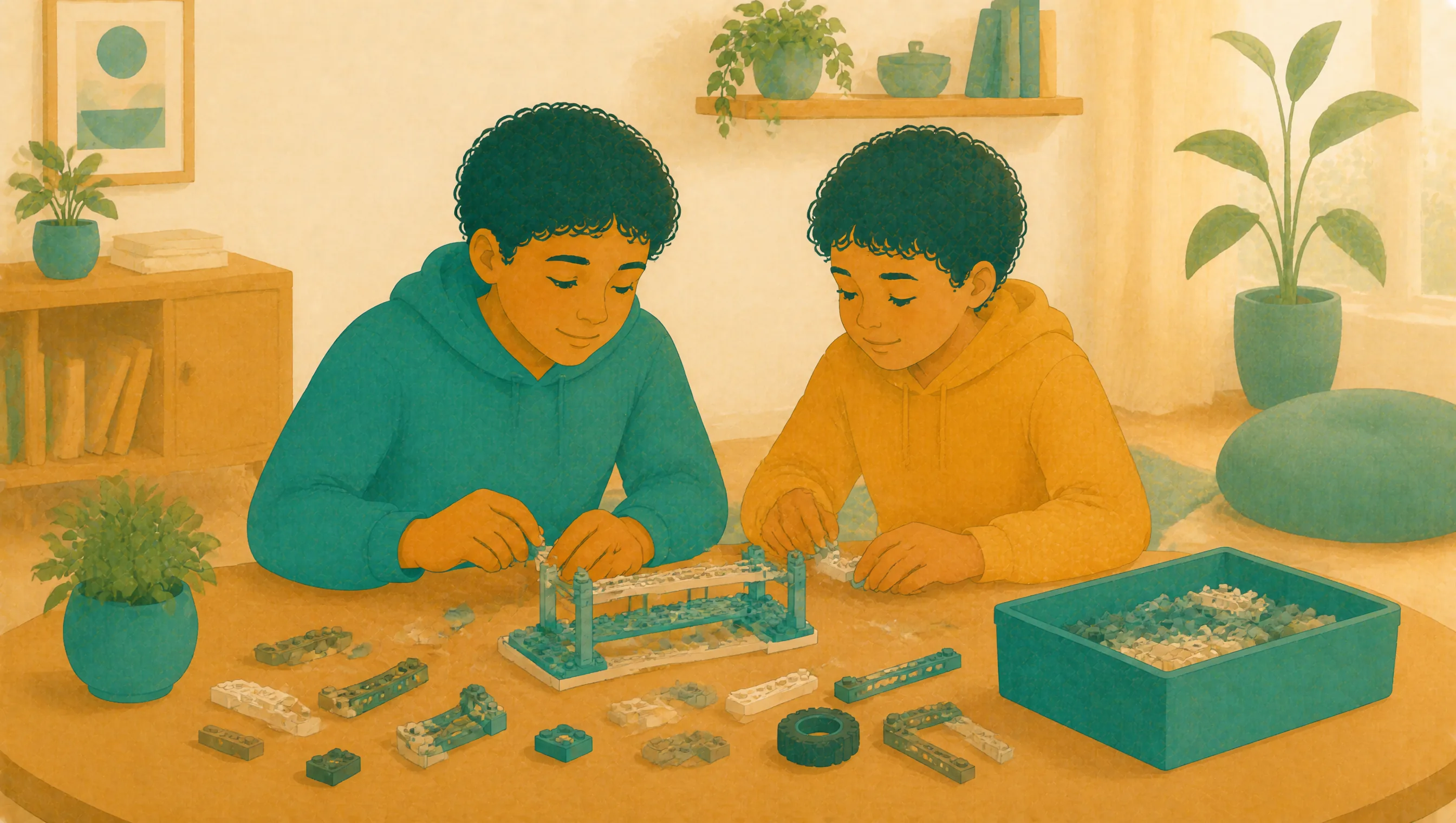
Give the meeting a known activity and ending. Forty minutes building a model may be easier than "come over for the afternoon".
Beforehand, agree:
- where the activity happens;
- what is available to share;
- how long it lasts;
- whether the child wants you nearby;
- where either child can take a break; and
- how your child can ask to finish without explaining publicly.
Avoid using the maximum time the child can tolerate. A shorter meeting with capacity left gives both children a clearer experience of the relationship.
Let their way of being together count
Two children may draw, sort, build or game beside one another with little speech. That can be wanted company. Do not fill every silence or demand eye contact to make the friendship visible.
The National Autistic Society describes wide variation in autistic communication, including processing, direct language and non-verbal expression.3 Accept speech, gesture, writing, symbols and AAC. Watch whether both children can influence the activity, say no and choose to remain.
If your child wants words for a difficult point, offer editable options:
"Do you want to build this part together?"
"I thought the rule was different. Can you show me?"
"I have had enough for today."
Do not require a polished delivery. The words are there to help the child express an intention, not to train a more typical social appearance.
Support the opportunity, not every exchange
You may need to send the invitation, arrange travel and prepare the activity. Agree what happens after that. Stay close enough for safety, unkindness or a problem the children cannot solve, but do not supply both sides of the conversation.
If the children are comfortable, leave the relationship room to become theirs. If they are not compatible, better adult prompting will not turn that into friendship.
The longer guide on how to help with friendships without taking over covers supervision, scripts, school support and when to step in.
Ask about the experience, not the performance
Afterwards, wait until your child has recovered, then ask:
- What part did you like?
- Was anything too loud, long or confusing?
- Did you want me closer or further away?
- Do you want to see this person again?
A no is useful information. A yes may still come with a request for a shorter visit or different activity. Do not ask whether they made a friend as though the meeting were an exam.
One good friend is not a treatment outcome, and friendship quality cannot be counted from the outside. The useful result is a child who had an accessible opportunity, remained able to say yes or no and can choose whether there is a next time.
If the answer is not yet, preserve the route back without pressure. Interests, classmates and preferred forms of contact change over time.
For the broader picture, use Friendships, Belonging and Social Confidence.
Footnotes
-
NHS guidance recommends gradual, individualised support and avoiding forced social activities. ↩
-
Newcastle Hospitals gives clinical guidance on shared interests, structured opportunities and environmental barriers. ↩
-
National Autistic Society guidance describes varied autistic communication and the importance of recognising individual forms of communication. ↩
Sources and further reading
- [1] National Autistic Society. Autism and communication (accessed 4 August 2026).
- [2] NHS. Supporting an autistic child (accessed 4 August 2026).
- [3] Newcastle Hospitals NHS Foundation Trust. Understanding and supporting the social interaction of autistic children and young people (accessed 4 August 2026).
The Family Reset System
Need more than one answer?
Membership opens the full FamilyFX Library and brings the articles together with eight modules, fourteen deep guides, practical packs, document-building tools and My FamilyFX. It costs £79.99 a year, and NeuroFX patients can use an access code for a free first year.
See what is included →