
FamilyFX: The Family Reset System

Why does my child cope at school and fall apart at home?

Why an autistic child may appear to cope at school but show strain at home, and how families and schools can compare the demands and hidden support.
By FamilyFXWritten December 2025Published 6 August 2026Last reviewed 19 June 2026Next review due 19 June 20278 min readReviewed by FamilyFX
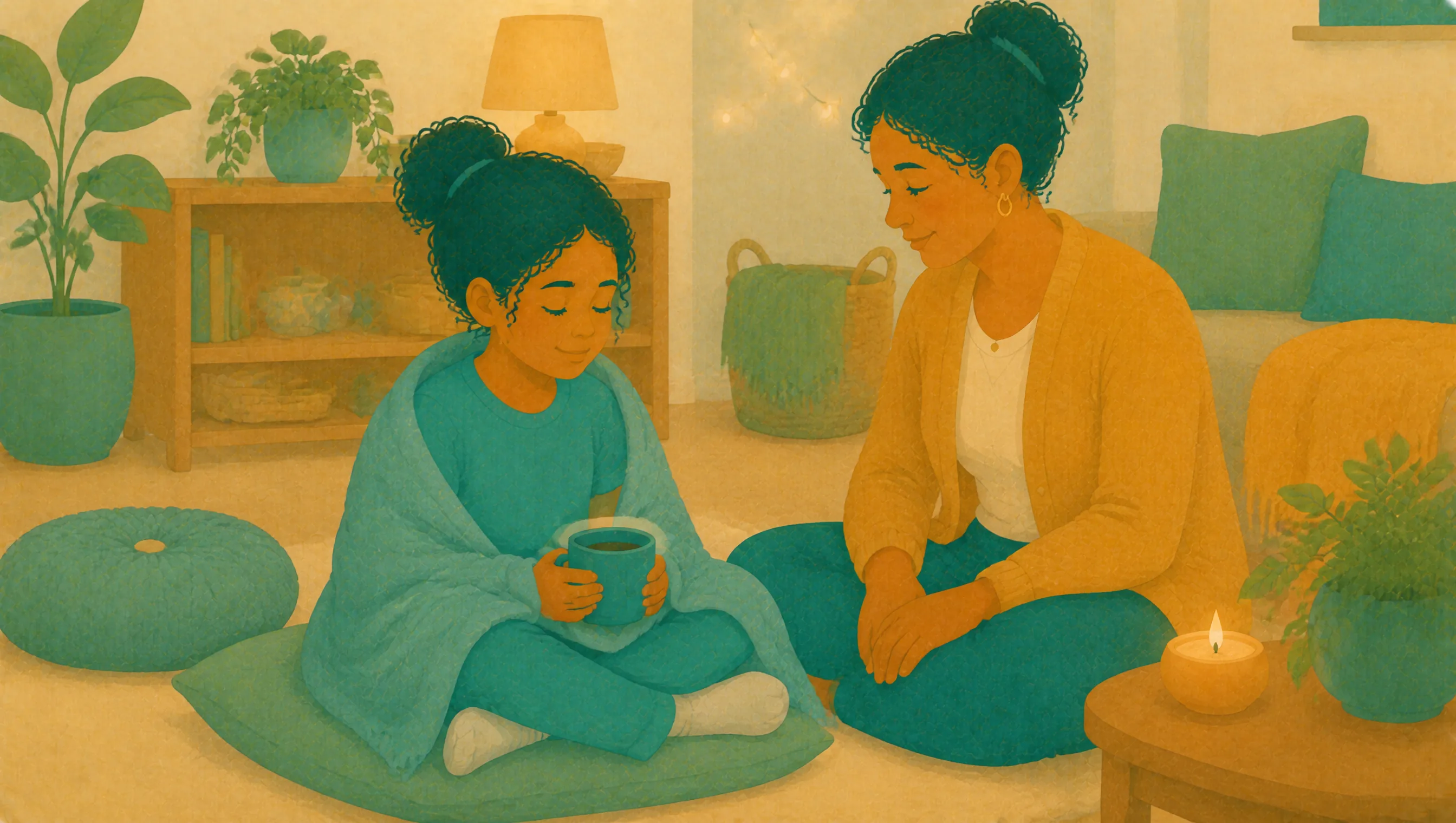
A girl sits wrapped in a blanket on a floor cushion holding a warm drink with both hands, while her mother sits close by on another cushion with her hands resting in her lap.

The short answer

School and home may see different but equally accurate parts of an autistic child's experience. A predictable timetable, copied peer cues, adult prompting or intense self-monitoring may help the child get through school while sensory, social and uncertainty load accumulates. Home may be the first place safe enough to stop holding everything together. This pattern is not proof of masking and can have other explanations, but it deserves investigation. Compare specific demands, support, effort and recovery across settings; reduce the school-day load where possible and protect a low-demand transition home.

  • Different behaviour across settings does not mean one account is false.
  • A calm appearance may depend on structure, prompting, copying or suppression.
  • The cost of school may appear through exhaustion, withdrawal, physical symptoms or distress later.
  • Masking is one possible mechanism, not a complete explanation for every child.
  • Support should reduce the load before crisis rather than focus only on behaviour at home.

The teacher describes a quiet, capable child. At home, the same child cannot answer questions, cries over a small change, hides under a blanket or erupts when asked to take off their shoes. Families can feel disbelieved; schools can feel they are being told about a child they do not recognise.

Both accounts may be true. Behaviour changes with setting, support, expectations and accumulated load. The useful task is not deciding who has the real child. It is finding what each setting reveals.

School and home ask for different things

School often provides visible structure: bells, timetables, assigned seats, repeated routines and other children showing what happens next. It also brings crowds, noise, smells, rapid transitions, group language, social uncertainty and less control over breaks.

Home may be quieter and more flexible, but its structure is often less visible. The child has reached the end of a demanding day, choices replace the timetable, siblings add unpredictability and spoken reminders continue when processing capacity is low.

The same child can function differently under these conditions without deciding to behave for one adult and not another.

A successful result can hide its support

“They complete the work” does not tell you how. The child may wait for a classmate to begin, copy the layout, rely on private prompts, stay in at break or work through mounting sensory discomfort. Familiar staff may provide dozens of small adjustments without naming them as support.

Ask:

  • Can the child begin after a whole-class instruction?
  • How often does an adult clarify or redirect privately?
  • Can they say that they are confused, in pain or need a break?
  • Do they eat, drink and use the toilet?
  • What happens with supply staff or room changes?
  • How do they manage group work, lunch and break?
  • What recovery do they need after school?

This turns “fine” into a description of functioning, independence and cost.

Holding it together can take active work

Some autistic children monitor other people, rehearse phrases, copy gestures, suppress movement or conceal confusion to reduce social risk. This is often called masking or camouflaging. It may be deliberate, partly conscious or something the child cannot yet name.

Research with autistic adolescent girls found that many participants reported camouflaging across much of the school day and valued adult awareness and time alone to recover [3]. That study cannot establish that every home-school difference is masking. Pain, bullying, anxiety, learning difficulty, hunger, sleep loss and other neurodevelopmental needs must also be considered.

Use the idea as a question, not a conclusion: what effort is invisible here?

Home may be where control is released

A child often releases strain with people and in places that feel safe. This does not mean the distress is calculated or that family relationships cause it. The nervous system no longer has to preserve a classroom appearance.

Release can look like crying, shouting, repetitive movement, silence, retreat, urgent use of screens, refusal of all decisions or an intense reaction to a small request. The final request may be the point at which capacity ended, not the whole cause.

The separate article on after-school meltdowns addresses escalation and immediate response. Here, the focus is the wider discrepancy and what it tells adults about access.

Some children show the reverse pattern

Home may be comfortable while school sees distress, withdrawal or behaviour that creates concern. At home, communication is familiar, sensory input is adjustable and the child controls the pace. School removes those supports.

The same method applies. Compare conditions rather than character. A child does not need to struggle visibly everywhere for their difficulty in one environment to matter.

For autism assessment, NICE recommends seeking information from another setting when the clinic account and reported experience do not match [1]. Difference across settings is evidence to understand, not a reason to stop asking.

Protect the transition home

The first period after school is often a poor time for questions, chores and decisions. Create a predictable landing routine based on the child's needs. It might include:

  • a quiet journey with little conversation;
  • immediate access to a drink and familiar food;
  • comfortable clothes;
  • movement, pressure or a low-sensory space;
  • a known activity with no performance demand; and
  • one visible indication of what happens later.

Ask the child whether company or solitude helps. Avoid making them earn recovery by describing the day. Essential information can wait until language is more available.

A transition routine is not a reward for coping. It is access after sustained demand.

Reduce the school-day cost

Home recovery matters, but it should not become the only response. If a child must spend every evening rebuilding enough capacity to return, examine the day itself.

Possible adjustments include:

  • a quieter arrival or lunch option;
  • a clear route to request a break;
  • written instructions and advance notice of changes;
  • permission to move or use regulating objects;
  • reduced copying and unnecessary social performance;
  • a trusted adult who checks understanding privately;
  • structured choices at break; and
  • fewer demands during the final part of the day.

NICE asks professionals to consider communication, sensory factors, the physical and social environment, routine change and predictability when behaviour or distress occurs [2]. Adjustments should respond to the identified barrier, not aim merely for a quieter child.

Build a shared comparison

Choose three recurring situations, such as instructions, transitions and unstructured time. Ask home and school to describe:

  1. What the child is expected to do.
  2. What support is already present.
  3. What the child does visibly.
  4. Signs of effort or distress.
  5. What happens afterwards.

Compare like with like. Homework at six in the evening is not equivalent to a preferred classroom activity at ten in the morning. A one-to-one meeting does not reproduce a crowded lunch hall.

Use neutral examples:

In class, Ari begins when the teaching assistant points to the first item. At home, a spoken instruction to start homework is repeated six times and ends in distress. Could we trial the same visible first-step cue at home and ask whether he can use it with less adult prompting at school?

That creates a testable support rather than an argument.

Share patterns, not only incidents

Communication between home and school often begins only after a difficult event. That makes it easy for each side to see isolated behaviour rather than the build-up. A brief shared record can include significant changes, missed food or breaks, support that was needed and the child's state on arrival or return. It should not become a minute-by-minute surveillance log or a list of faults.

Agree which information is genuinely useful. A parent may need to know that the usual teacher was absent, not every minor classroom correction. School may need to know that the child slept for three hours, not a full account of the evening. Include successful adjustments so that the record identifies what protects capacity as well as what goes wrong.

Keep the child informed in a way that matches their age and communication. Adults exchanging secret reports can increase anxiety and mistrust. Explain what is being recorded, who will see it and how it will be used to make the day more manageable.

Listen without requiring a polished explanation

The child may not know why the day was hard. “Nothing” or “fine” can mean that speech, memory or emotional interpretation is unavailable. Offer lower-demand routes: a body outline, scale, list of places, drawing, typed message or conversation while walking.

Do not insist that they admit to masking. Ask about concrete moments: Where is the noisiest place? When can you stop talking? Who helps when the instructions change? What takes the most energy?

Children discussed in why some autistic children are missed often need adults to look at effort and recovery rather than attainment alone.

Separate recovery from avoidance

A low-demand period after school may be essential, but it can gradually expand until eating, sleep, medical needs or all family contact become inaccessible. Review what the child is recovering from and whether the school-day load can be reduced. Do not keep adding recovery around an unchanged source of harm.

At the same time, forcing immediate participation to prevent “avoidance” can deepen exhaustion. Use a planned re-entry: quiet until a visible time, then one necessary action with support. Keep the first request small and predictable.

If the child cannot recover before bedtime, wakes unable to attend, or shows a steady loss of skills and activities, the pattern needs broader review. Consider physical health, sleep, bullying, learning fit, anxiety and other sources of strain alongside autism.

Keep siblings and parents in the plan

After-school distress affects the household. Siblings may receive noise, disrupted plans or less adult attention. Parents may spend the whole evening anticipating the next trigger. A child-centred plan can acknowledge these realities without blaming the autistic child.

Use separate spaces where possible, prepare siblings in simple language and protect some predictable adult time for each child. Divide essential tasks between adults when available. Ask school to recognise that a “successful” day whose full cost is transferred to the family is not fully accessible.

A useful next step

For one week, record the first hour after school alongside three facts about the day: unusual changes, unstructured demands and support used. Do not search only for bad behaviour. Note quiet withdrawal, physical symptoms and the time recovery takes.

Choose one change at school and one change in the transition home. Review whether the child reaches the evening with more access to communication, food, rest and family life. The aim is not to make both settings report identical behaviour. It is to reduce the amount the child has to survive unseen.

Sources and further reading

  1. [1] NICE. Autism spectrum disorder in under 19s: recognition, referral and diagnosis (accessed 4 August 2026).
  2. [2] NICE. Autism spectrum disorder in under 19s: support and management (accessed 4 August 2026).
  3. [3] Cook and colleagues. A round, bruising sort of pain: autistic girls’ social camouflaging in inclusive high school settings. Study of autistic female-identifying adolescents; masking findings cannot be generalised to every child.. 2025 (accessed 4 August 2026).