
How do I build everyday independence with chores, money and travel?
Teach one useful household, money or travel task at a time, keeping tools and chosen support in place as the teenager gains control.
The short answer
Choose one real task the teenager wants or needs to do. Define it precisely, identify the part they can already manage and find the point where support is needed. Independence can mean choosing, doing one part, using an aid, directing another person or knowing when to ask for help. For a chore, make the finished state visible and teach the sequence in the place where it happens. For money, begin with one purpose, an agreed amount and a way to notice a payment or mistake. For travel, practise one route, including tickets, road safety, the destination and what to do when transport changes. Use reminders, labels, checklists, spending alerts, route cards or accompanied practice as tools, not signs that the skill is false. Agree the safety boundary and a route back to help. Review after real use and change the support at the failed point. Do not make a teenager manage medication, banking or travel alone merely because of age, and do not treat one mistake as evidence that they are incapable. This article builds early everyday practice; the Preparing for adulthood resources cover the wider post-16 systems and service transitions.
- Define one useful task instead of pursuing independence as a general quality.
- Begin with the teenager's reason for wanting the task and the part they already manage.
- Keep tools, adjustments and chosen help where they improve access or safety.
- Practise the unexpected part, not only the ideal sequence.
- Review the point that failed rather than withdrawing the whole opportunity.
"Be more independent" does not tell a teenager what to do. It can also turn help into something they must refuse to prove they are growing up.
Choose a task that matters. Independence develops through useful control over that task, with support shaped around the parts that remain difficult.
Begin with the teenager's reason
An adult may value clean rooms and balanced budgets. The teenager may value finding their headphones, buying lunch without asking or travelling to see a friend.
Ask:
- What would you like to do with less adult involvement?
- Which task would give you more privacy, time or choice?
- Which part do you already know how to do?
- Which part do you want help learning?
- What kind of reminder or backup would feel useful rather than intrusive?
Motivation does not remove access barriers, but it gives the practice a purpose. Begin with something the young person can use in their actual week.
NICE transition guidance recommends treating the young person as an equal partner and agreeing goals around matters that can include independent living and community participation.1 That guidance concerns health and social-care transitions, but the principle of shared goals is useful for everyday teaching.
Define the task so it can be practised
"Help around the house" is broad. "Empty the bedroom bin into the outside bin every Sunday before dinner" is observable.
"Manage money" may begin as "Use £8 to buy lunch and keep the bank card secure." "Travel independently" may begin as "Take the number 12 bus from school to the library and contact an adult if it is cancelled."
Write:
- where the task begins;
- the steps that matter;
- what complete looks like;
- the known safety limit; and
- how the teenager can obtain help.
Avoid adding hidden standards during the task. If the bin must be relined, teach that step rather than criticising it afterwards as obvious.
Find the current edge of the skill
Ask the teenager to show what they can do. Do not take over at the first pause.
They may be able to:
- identify what needs doing but not begin;
- complete the physical task but lose track of time;
- follow a familiar sequence but not respond to a change;
- choose safely but struggle to communicate the choice;
- use a bank card but not recognise a subscription or scam; or
- travel the route but not know where to wait after a cancellation.
Teach or support the next edge. Independence is not all-or-nothing. A person can direct another adult, use technology, ask for a prompt or complete one part of a shared task.
Teach a household task where it happens
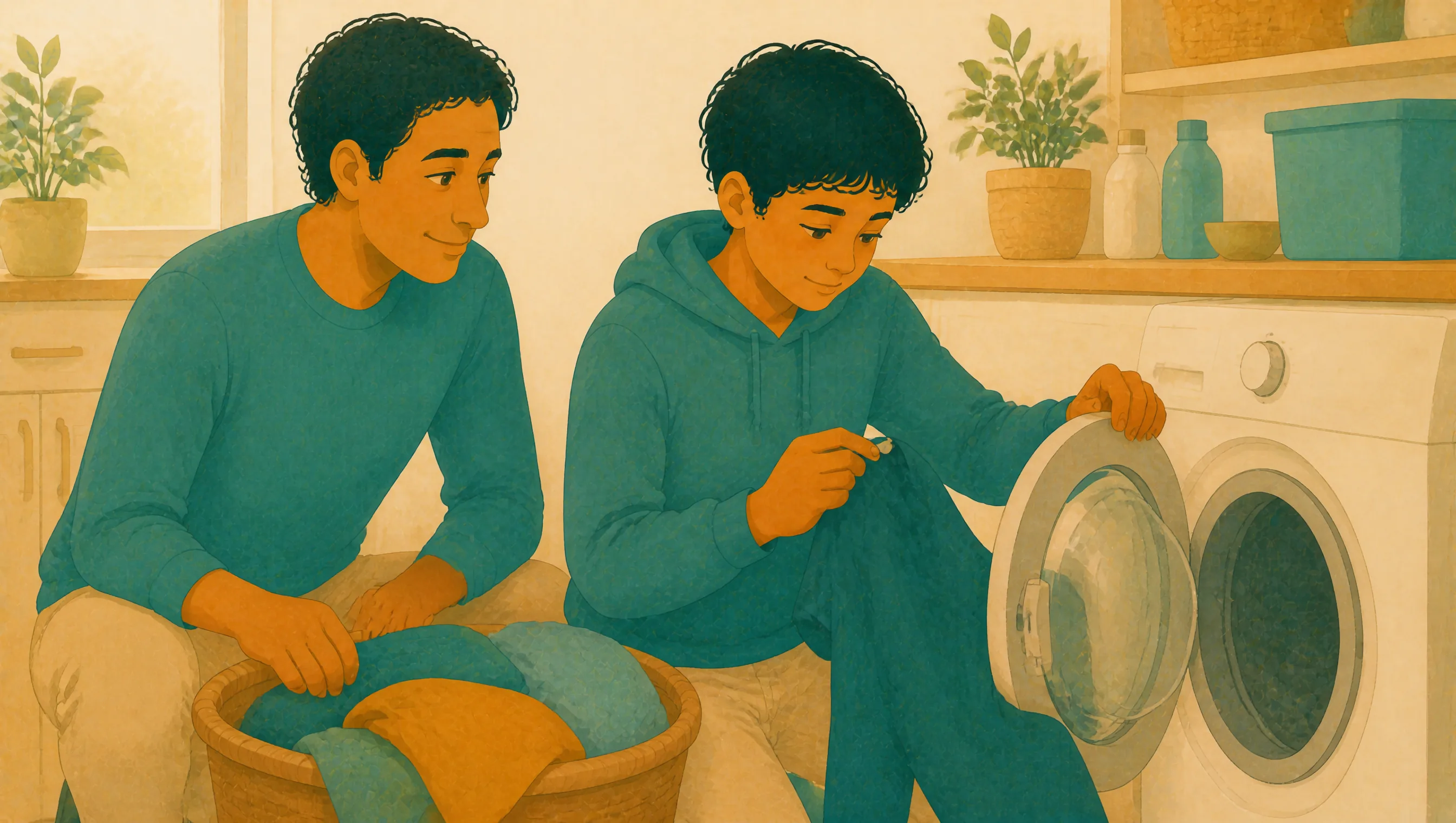
Choose a real task: laundry, a meal, rubbish, cleaning, shopping or caring for an item. Make the finished state visible with a photograph, short list or demonstration.
For laundry, the sequence might be:
- put worn clothes in the named basket;
- check pockets;
- choose the familiar machine setting;
- add the measured product;
- move clothes when the alarm sounds; and
- put dry clothes in the correct place.
The teenager may own only the first two steps initially. That is still meaningful participation. Add another step when the current sequence is reliable enough.
Use tools openly. Labels, measured containers, colour coding and phone prompts are part of the system. Do not remove them only because the teenager has used them for several weeks.
Make money practice bounded
Begin with one purpose and amount. Explain how payment works, what the balance means and how to check that a transaction happened once.
Useful protections may include:
- a separate spending amount;
- alerts for payments;
- limits set with the teenager;
- a written rule for sharing card details or codes;
- checking a seller before paying;
- a pause before subscriptions or in-app purchases; and
- an agreed adult contact for a mistake or suspicious request.
Practise what to do after an error. A declined payment, lost card or duplicate purchase can become a sequence: stop, check, freeze the card if needed and contact the provider or trusted adult.
Do not ask a teenager to share every purchase indefinitely without a specific reason. Agree which money is theirs to use, what oversight remains and when the arrangement will be reviewed.
Teach one journey, including the disrupted version
Map a single route. Include:
- start and destination;
- road crossings;
- stop, platform or landmark;
- ticket, pass or payment;
- expected time;
- safe waiting places;
- phone charge and contact details;
- what happens if transport is late or cancelled; and
- the point at which the teenager stops and asks for help.
Practise in stages. Travel together. Let the teenager lead while you follow. Increase distance or reduce prompts. Then rehearse one change rather than engineering a frightening surprise.
Local independent travel training can cover journey planning, tickets, road safety, personal safety and unexpected situations, but availability and criteria vary.2 The short guide to starting one independent journey helps you prepare before asking locally.
Make support easy to request
A safety plan that depends on a long explanation may fail when the teenager is overloaded. Agree a phrase, message or icon.
PLAN B means the route has changed and I need you to tell me the next safe step.
CHECK means I am about to pay and want you to look at the seller, not take over the purchase.
Give the teenager more than one adult route where possible. Include addresses or numbers on paper if a flat battery is a realistic problem.
Support should be dependable. If asking for help always produces criticism, the teenager may hide a manageable mistake until it becomes more serious.
Practise without creating a pass or fail test
Keep the first attempt low enough in consequence. Cook when there is backup food. Practise a journey in daylight. Use a small amount of money. Try the household task without a deadline that affects everybody.
Afterwards ask:
- Which part was straightforward?
- Where did the plan stop matching reality?
- Did the tool help?
- Was the adult too close, too far away or useful?
- What would make the next attempt safer or easier?
Do not add several new steps because one attempt went well. Repetition can consolidate the route before difficulty increases.
Transfer responsibility in pieces
Responsibility includes noticing, planning, doing, checking and recovering from a problem. These can move at different times.
A teenager might cook independently while an adult notices that ingredients need buying. They might choose spending while a parent reviews an unfamiliar contract. They might book an appointment but ask an adult to attend. Make this division explicit so invisible work does not remain a source of conflict.
For medication, involve the prescriber or pharmacist in safe-use and storage planning. Do not transfer full responsibility because of a birthday if the young person cannot yet recognise the medicine, dose, timing, interaction or action after an error.
Keep contribution separate from punishment
Household tasks can teach skills and make family work visible. They should not appear only after conflict. Agree the task, support and timing as part of the ordinary week.
Choose work that has a genuine purpose and a fair boundary. A teenager may cook one meal, feed a pet, empty a bin or put away their own clothes. Do not quietly add responsibility for a sibling's care, an adult's emotional state or constant household monitoring because the teenager is becoming more capable.
If the task is shared, name both parts:
You load the dishwasher after dinner. I check whether tablets need replacing and start the machine until we have practised that step safely.
Payment can be appropriate for agreed extra work, while ordinary family contribution may be unpaid. Explain the distinction instead of changing it according to whether the teenager cooperated. The aim is to understand work, ownership and money, not to make every act of care transactional.
Connect practice to later planning without making it a countdown
England's SEND code identifies independent living and community participation as part of preparing for adulthood planning.3 Other UK nations use different education systems. Everyday practice is useful regardless of whether a teenager has a formal plan.
This article owns the earlier practical skill: one chore, payment or journey. The guide to planning the wider transition before 18 separates education, health, benefits, decisions and daily life. The deeper post-16 article connects daily skills to adult support planning.
Do not bring every adult system into today's attempt to make lunch.
Keep the tools that make the skill usable
A checklist, reminder, bank alert or route card does not invalidate independence. Adults use calendars, maps, direct debits and saved shopping lists. The relevant question is whether the tool helps the teenager direct the task safely and with the amount of control they want.
Reduce support when it has become unnecessary or intrusive, not to prove a point. Restore it when health, stress or circumstances change. Everyday independence grows through a teenager knowing what they can do, what helps and how to respond when real life does not follow the first plan.
Footnotes
-
NICE NG43 concerns transition from children's to adult health and social-care services. It supports young-person-led goals but does not prescribe the household teaching steps in this article. ↩
-
Oxfordshire's travel-training information illustrates possible content of a local service. It does not establish availability or eligibility elsewhere. ↩
-
The SEND code of practice applies to England. Wales, Scotland and Northern Ireland use different education law, plans and terminology. ↩
Sources and further reading
- [1] NICE. Transition from children's to adults' services for young people using health or social care services. NG43. February 2016; current recommendations (accessed 4 August 2026).
- [2] Department for Education and Department of Health and Social Care. SEND code of practice: 0 to 25 years. January 2015; applies to England (accessed 4 August 2026).
- [3] Oxfordshire County Council. Independent travel training for young people with special educational needs and disabilities. Current local-service guidance (accessed 4 August 2026).