
What do parents tend to notice first? Autism in the early years
A developmentally careful guide to possible early signs of autism, what else may overlap and how to raise a concern without trying to diagnose at home.
The short answer
Possible early signs of autism concern a pattern across communication, shared attention, play, repetition, response to change and sensory experience. A young child might use gestures differently, respond to their name inconsistently, repeat movements or play, develop language in an unusual pattern, or become intensely distressed by particular sounds, textures or changes. Many individual signs also occur in children who are not autistic, and some autistic children show them subtly or later. Record concrete examples, check hearing and wider development, and discuss concerns with a health visitor, GP, nursery SENCO or other appropriate professional.
- Look for a developmental pattern rather than one sign.
- Early communication includes gesture, gaze, movement, sound and shared attention, not speech alone.
- Repetition, sensory responses and reaction to change matter alongside social communication.
- A child can be affectionate, smile, use eye contact or pretend and still be autistic.
- Support for communication and access can begin before assessment.
Parents often ask which sign comes first. There is no single reliable answer. One family notices that their toddler rarely points to show something interesting. Another notices repeated movements, intense distress at ordinary sounds or play that follows the same sequence every time. Some see a difference early; others only recognise the pattern later.
Possible signs are useful when they prompt careful observation and support. They become less useful when treated as a test a parent should score alone.
Look for a pattern across development
NICE describes possible autism features across social interaction, communication and restricted or repetitive behaviour [1]. In young children, these areas overlap. A repeated game may be both a source of joy and a way to connect. Looking away may help a child process speech. A familiar phrase may carry more meaning than its literal words suggest.
Notice what the child does, how often, in which settings and what changes the response. One isolated behaviour says little. A consistent pattern across several areas is worth discussing, particularly when it affects communication, participation or family life.
Early communication is bigger than speech
Before and alongside words, children communicate through gaze, gesture, facial expression, movement, sound, objects and shared attention. Possible differences can include:
- responding to their name only in some circumstances;
- using fewer gestures such as pointing, showing or waving;
- reaching for an adult's hand and leading them to an object;
- looking at an object without checking whether another person is sharing the moment;
- repeating sounds, words or longer phrases;
- using language mainly to request, label or recite rather than to exchange ideas;
- finding open questions much harder than familiar ones; or
- losing access to words when tired, upset or in an unfamiliar place.
None means that the child does not want to communicate. Work out the child's current routes and respond to them. If they place your hand on a container, name the likely message and open it. Add a gesture, picture or simple word without withholding the thing until they copy you.
Research following infants with an increased family likelihood of autism has found early group differences in social communication, attention, movement and repetitive behaviour. The same research also shows why caution matters: some early markers were present in children who were not later diagnosed [3]. Early observation can identify a need for support; it cannot reliably settle diagnosis from one moment.
Play may develop differently
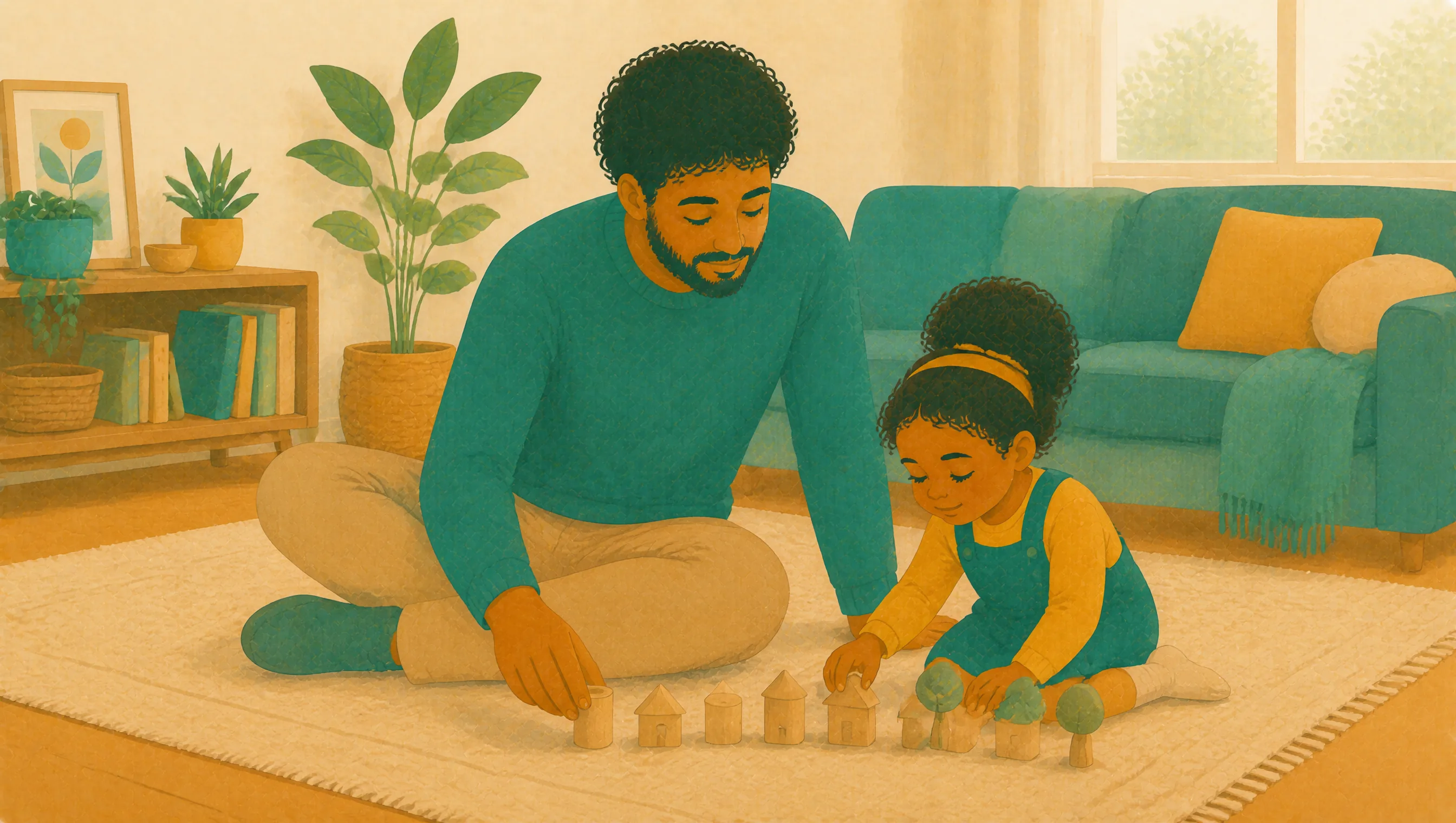
A young autistic child may explore how objects move, sound, feel or fit together. They might spin wheels, open and close doors, arrange items, carry a particular object or repeat a scene exactly. Some use pretend play; others use it less, later or in a highly scripted form.
Join before redirecting. Copy the child's action, add a sound, or place another object alongside theirs and pause. The aim is not to make their play look conventional. It is to discover whether shared attention can grow from something the child already finds meaningful.
Pretend play does not rule autism out. NICE explicitly warns against doing so [1]. A child may reproduce entire stories, use rich imagination alone or control the parts of a game closely because other people's unexpected changes are difficult.
Repetition and intense interests
Parents may notice rocking, hand movements, jumping, pacing, humming or repeated speech. A child may watch the same short section of a programme, ask the same question despite knowing the answer, or become absorbed in letters, vehicles, water, animals or a particular household object.
Repetition can provide sensory feedback, pleasure, expression and predictability. Observe when it increases and what happens afterwards. Harmless repetition usually needs understanding, not suppression. If an action causes injury, prevents eating or sleeping, or appears suddenly with pain or illness, the response needs to address that specific risk or cause.
The guide to repetition and stimming covers this in detail.
Change may feel much larger than it looks
A different cup, route, coat or order of events can provoke intense distress. The issue may be uncertainty rather than the object itself. The child had a reliable picture of what would happen, and the changed detail removed that reliability.
Notice whether advance information, a visual sequence, seeing the replacement or keeping another part familiar helps. Do not deliberately introduce surprise to test flexibility. Small, supported changes teach more than avoidable overwhelm.
Sensory responses can be easy to miss
Young children may not be able to say that a hand dryer hurts, clothing scratches or the room seems visually chaotic. They communicate through avoidance, covering ears, removing clothes, seeking pressure, staring, movement, chewing or distress.
They may also respond less to some sensations. A child might not notice cold, minor injury or a wet nappy promptly, while finding another sensation unbearable. Always consider physical causes when behaviour changes. Autism does not prevent earache, constipation, dental pain or illness.
Record the exact sensory setting. “Hates shops” is less useful than “covers ears and drops to the floor beside the freezer alarms; manages a smaller shop at a quiet time”. The second account points towards a practical adjustment.
Affection and eye contact are not tests
Some autistic children seek cuddles, smile readily and look directly at familiar people. Others avoid some kinds of touch or eye contact. Both patterns can change according to person, setting and stress.
NICE says clinicians should not rule autism out because a child uses eye contact, smiles, shows affection to family, takes part in pretend play or reached language milestones [1]. These behaviours reveal something about this child, not a pass or fail result.
Similarly, a child who does not respond in an expected way should not be described as detached. They may show connection by returning to a familiar person, relaxing near them, sharing an object, copying a movement or seeking help.
What else might explain the signs?
Hearing differences, language disorder, developmental delay, learning disability, ADHD, anxiety, motor differences and physical health can overlap with possible autism features. More than one condition may also be present.
This is why developmental review matters. A hearing check may be appropriate when response to name or spoken language is uncertain. A speech and language therapist may assess how the child understands and communicates. The health visitor or GP can consider wider development and referral routes. Nursery observations can show how the child manages around peers and group routines.
Do not wait to identify the perfect explanation before responding to a clear need. A child who cannot understand long spoken instructions benefits from simpler language regardless of the eventual diagnosis.
Prepare useful information
For two weeks, collect brief examples under five headings:
- How the child requests, refuses and shares interest.
- How they play alone and with another person.
- Repeated movements, language, play or interests.
- Responses to change and unfamiliar situations.
- Sensory experiences and recovery.
For each, note what happened before, what the child did, what adults tried and what helped. The behaviour decoder can structure this without assigning a diagnosis.
Include comfortable moments. A description of when the child communicates freely, tolerates a transition or enjoys shared play helps professionals understand the conditions that support them.
Differences between home, nursery and an appointment are common and worth describing, not smoothing out. A child may follow the nursery routine by watching other children, then need a long recovery at home. Another may communicate freely with a parent but become quiet when several adults speak. A brief, calm appointment may show neither pattern. Ask each setting for concrete examples and note the amount of prompting, familiarity and preparation already built into the moment.
Short videos can sometimes show an everyday interaction that is difficult to recreate in a consulting room, provided the child is comfortable and the professional is willing to view them. Choose a few brief examples rather than trying to record everything. Explain what happened before and after the clip, because an isolated movement or phrase can easily be misunderstood without its context. Written observations are equally useful when filming would intrude on the child.
If you have a developmental record, nursery notes or a hearing report, bring those as well. They can help place recent observations within the child's wider development.
What to say when raising a concern
You do not need to arrive with a label. Try:
I am noticing a pattern across communication, play and response to change. At home, she leads us to what she wants but rarely points to show us something. At nursery, she becomes distressed when the activity order changes. Could we look at her development and decide what support or referral is appropriate?
The wider guide to autism in children explains what assessment may involve. Pathways and waits vary, but support for communication, sensory access and nursery participation can begin now.
A useful next step
Choose one recurring moment, such as getting dressed, nursery arrival or shared play. Replace a broad judgement with a precise observation. Then make one adjustment that matches what you saw: less language, a picture, more processing time, a quieter space or a familiar sequence.
Take the observation and its result to the next conversation with your health visitor, GP or nursery. It is evidence about your child's development, and it is already helping you understand what makes participation easier.
If the first professional is not concerned but the pattern continues, keep recording examples and return to the conversation. Different adults see different parts of a young child's day. A calm appointment or one comfortable nursery session cannot show every communication or sensory demand the child meets across a week.
Sources and further reading
- [1] NICE. Autism spectrum disorder in under 19s: recognition, referral and diagnosis (accessed 4 August 2026).
- [2] NHS. Signs of autism in children. Page last reviewed May 2026 (accessed 4 August 2026).
- [3] Zwaigenbaum and colleagues. Behavioural markers for autism in infancy: a prospective study of at-risk siblings. Prospective research in children with and without a family history; markers were not unique to later autism.. 2015 (accessed 4 August 2026).