How do we talk about strengths without pretending the hard parts are not there?
A grounded way to recognise a child’s strengths, interests and values without using positivity to minimise difficulty or deny support.
The short answer
Start with what you have observed in this child, not a list of talents attributed to ADHD or autism. Name the ability, interest, value or contribution precisely and include the conditions that let it appear. Ask whether the child values it and whether they connect it with their diagnosis. A quality can be useful in one setting and costly in another: deep focus may support expertise and make stopping painful; sensitivity may support close noticing and also bring overload. Do not require a strength to compensate for disability or turn an interest into work. Honest strengths-based language can hold two facts together: the child has abilities and qualities worth recognising, and some parts of life remain difficult enough to need support.
- No diagnosis gives every child the same strengths.
- Describe a specific ability, value, interest or contribution and the context in which it appears.
- The child decides whether a quality matters to them and whether it belongs in their diagnostic story.
- A strength can need support and can have costs in another setting.
- Positive language should never be used to refuse treatment, adjustment or acknowledgement of harm.
Families are often encouraged to balance every difficulty with something positive. The intention may be kind, but the timing can make a child feel unheard.
"ADHD makes school exhausting."
"But it makes you creative."
"Being autistic means I cannot bear lunch."
"It is also your superpower."
The reply changes the subject. The child was describing a problem that still needs help.
Strengths matter. They need to be true, recognisable and allowed to exist beside difficulty.
A strength is not a diagnostic promise
Lists of ADHD strengths often include creativity, energy, spontaneity, humour, courage and intense focus. Autism lists may include honesty, memory, loyalty, attention to detail, logic and expertise. Some children recognise several of these. Some recognise none.
Research can describe themes reported by participants, but it cannot turn those themes into traits delivered by a diagnosis. In a 2022 study, a self-selected group of adults with ADHD reported qualities including creativity, dynamism, flexibility and social or emotional strengths [3]. The participants were adults recruited through an ADHD and dyslexia organisation. The study does not show that ADHD caused those qualities or that they are common to all children.
The short FamilyFX review of ADHD strengths in children looks at this evidence and a small child study in more detail.
Begin with the child in front of you. A diagnosis may help them interpret a quality, but it should not supply one they are expected to perform.
Name what you can see
Broad praise is hard to examine. A precise observation gives the child something they can accept, reject or understand differently.
Instead of "You're so creative," try:
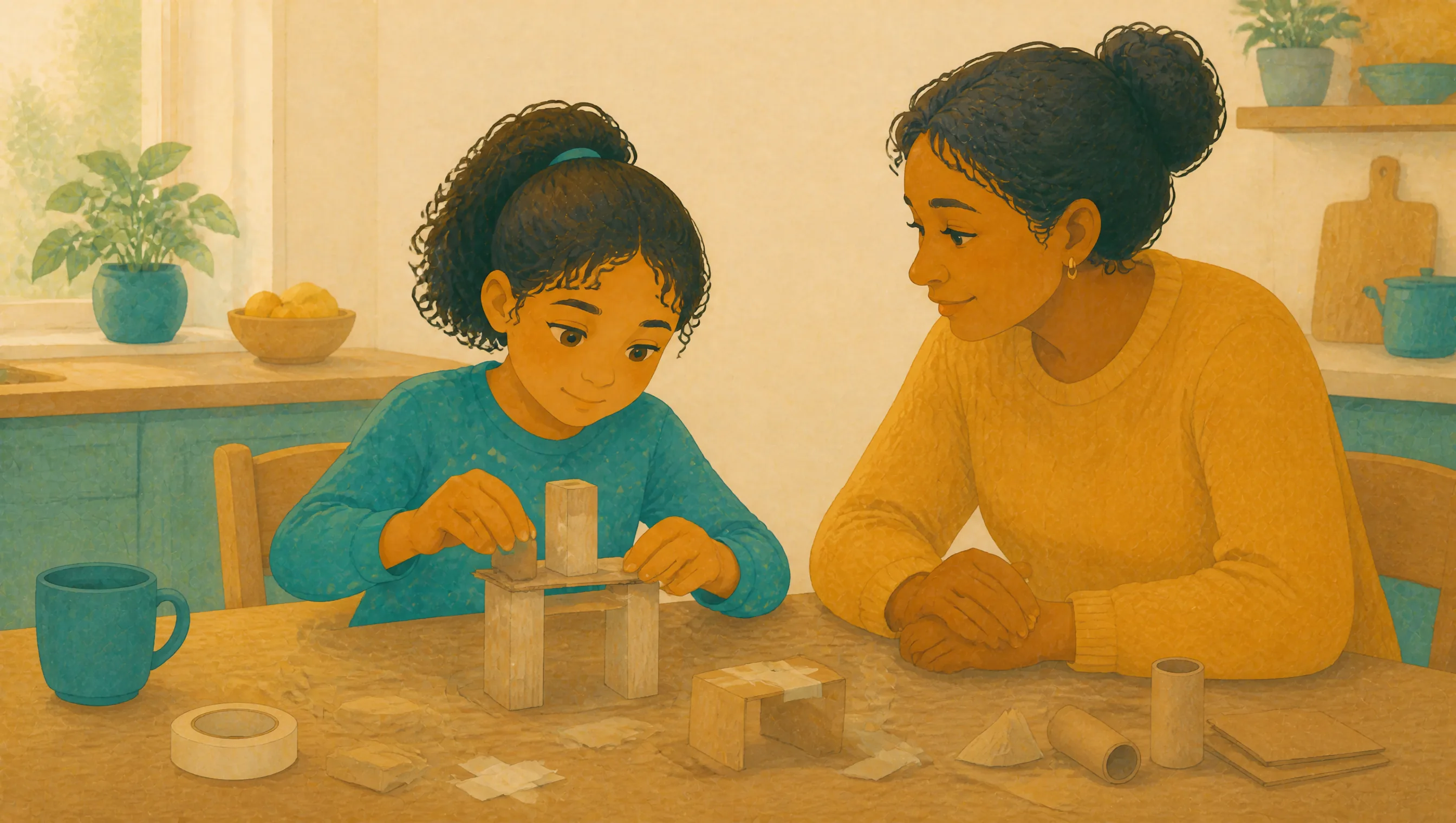
You found another route when the first design would not hold.
Instead of "You're caring," try:
You remembered that Leila finds birthdays difficult and asked before singing to her.
Instead of "Your memory is amazing," try:
You remembered the sequence of stations after seeing the map once.
Precision does not drain warmth from praise. It shows that the adult paid attention.
Describe values and contributions as well as skills. A child may care about fairness, persist with a chosen craft, make a sibling laugh or notice when an animal needs space. These do not have to become exceptional talents to count.
Include the conditions
Abilities are often uneven. A child may explain a complex idea aloud and struggle to record two sentences. They may remember detailed facts about a subject they love and forget a routine instruction. They may be funny with familiar people and unable to speak in a pressured group.
Add the context:
- "You solve visual problems well when you can move the pieces."
- "You remember the route when we preview it and you are not rushed."
- "Your ideas come quickly when you can speak before writing."
- "You stayed with the project for an hour because you chose it and knew the finish point."
Conditions are not excuses or footnotes. They tell adults how to create access. If a strength disappears in an inaccessible setting, the answer may be to change the setting rather than decide the strength was never real.
Let the child own the meaning
Ask:
Is that something you value about yourself?
Does it feel connected with ADHD or autism, or not?
Would you like more chances to use it?
The child may disagree. A teenager may say that adults call their attention to detail a strength when it feels like being trapped by an error nobody else notices. Another may value intense focus but not want it linked with ADHD. A younger child may not be interested in diagnostic meaning at all.
Do not persuade them into a positive identity. Accurate self-knowledge can include ambivalence: "I like this part sometimes and dislike what happens when I cannot stop."
One quality can help and hurt
Context changes the effect of a trait.
| Quality or pattern | May be useful when | May be costly when |
|---|---|---|
| intense focus | the subject matters and time is protected | eating, sleep or stopping are missed |
| directness | the group values clarity | other people expect hints or politeness formulas |
| quick ideas | brainstorming allows many possibilities | the task requires holding one sequence |
| sensory noticing | fine distinctions matter | the environment contains unavoidable noise or pain |
| persistence | the goal belongs to the child | an unresolved detail prevents rest or transition |
This is not a reason to avoid the positive description. It is a reason to finish the sentence. "You notice small changes quickly, and unexpected changes can also overwhelm you" is more complete than choosing either gift or deficit.
Interests do not have to become outputs
Autistic people may experience intense interests as sources of knowledge, identity, regulation, enjoyment and connection. A small qualitative study with autistic adults reported those themes [4]. It cannot predict what an interest means to one child, but it supports asking rather than assuming.
An interest can remain a place of rest. Parents do not have to turn maps into geography grades, drawing into a portfolio or gaming into coding. Constantly asking how an interest can become productive may remove the only part of the day that is free from evaluation.
Offer opportunity without taking ownership:
Would you like somewhere to display this, someone else who enjoys it, help getting materials, or for us to leave it as yours?
If the interest interferes with sleep, eating, safety or essential activity, address that specific effect. Do not shame the subject or remove it without providing another route to regulation and enjoyment.
Strengths can need support
A child can have original ideas and need help organising them. They can be thoughtful about friends and miss indirect social signals. They can understand advanced science and need substantial daily-living support.
Support does not cancel competence. It makes competence more usable.
The NHS says an autism assessment report should describe what a child is good at and what they may need help with [2]. NICE recommends discussing an individual person's strengths, needs and experience after an ADHD diagnosis [1]. Both belong in the account. Neither source provides a standard strength list.
When speaking with school, pair the observation with the access need:
Tariq explains historical cause and effect clearly in conversation. He needs a planning frame and an option to dictate before editing his written answer.
Eve notices when an animal's behaviour changes. She needs clear expectations and recovery time in the busy group session.
This is more useful than a strengths page that says "creative, kind, resilient" and never changes teaching.
Avoid praise that becomes pressure
A compliment can become a role the child has to maintain:
- "You are the calm one" may make distress feel like failure.
- "You are so mature" may reward not asking for help.
- "You always notice how everyone feels" may make the child responsible for other people's emotions.
- "You can focus when you want to" may be used as proof that attention difficulty is voluntary.
Notice the behaviour without fixing an identity around it. "You remained with your brother while he found an adult" describes a caring action. It does not assign permanent responsibility for the sibling's safety.
Also check whether praise is being used to secure compliance: "You're such a helpful girl" just before an unwanted task. Direct requests and genuine choice are kinder than approval the child has to earn.
Strength also changes with context. A child who notices detail in a quiet workshop may miss it in a crowded classroom. Someone who advocates clearly by message may be unable to speak in a meeting. Name the conditions rather than deciding the ability was exaggerated or has disappeared.
This makes a strengths record useful for planning. "Explains complex ideas when allowed to draw first" suggests an access route. "Excellent communicator" may cause adults to remove the preparation that makes communication possible. Accurate detail protects both confidence and support.
Allow strengths that are not convenient for institutions. Questioning an unfair rule, rejecting an inaccurate description or noticing that an adult has changed the terms can create friction and still reflect careful reasoning. The child will also need ways to use that ability safely and hear other perspectives. Honest strength-based writing does not require turning every conflict into praise.
Keep the hard part in the conversation
When the child describes pain, exclusion or frustration, respond to that first:
That sounds exhausting. We need to change how lunch works.
If they want, strengths can enter later:
You also said you like how deeply you know this subject. We can protect that without pretending the exhaustion is acceptable.
Do not use positive language to argue against medication, assessment or adjustments. A child can value an ADHD identity and want medication. They can value autistic perception and need substantial environmental change. They can reject a superpower story and still have healthy self-esteem.
Build an honest strengths record
Use four columns:
| What I notice | When it appears | What supports it | What the child says |
|---|---|---|---|
| explains ideas through diagrams | chosen science questions | large paper, no time pressure | "It is easier than paragraphs" |
| loyal to one friend | shared activity, clear plan | quiet meeting place | "I don't want lots of friends" |
Review the record with the child. Remove anything they dislike. Add difficulties that affect the same activity. Let it change.
The purpose is not to prove that neurodivergence is good or bad. It is to describe a whole person accurately enough that their ability is recognised, their difficulty is believed and the right support follows both.
Sources and further reading
- [1] NICE. Attention deficit hyperactivity disorder: diagnosis and management. 2018; last reviewed May 2025 (accessed 4 August 2026).
- [2] NHS. Autism assessments. Page last reviewed May 2026 (accessed 4 August 2026).
- [3] Schippers and colleagues. A qualitative and quantitative study of self-reported positive characteristics of individuals with ADHD. 2022 (accessed 4 August 2026).
- [4] Patten Koenig. Access points: understanding special interests through autistic narratives. 2025 (accessed 4 August 2026).