
Why does my child squint, cover their eyes or avoid busy places?
How to separate light, glare, movement, clutter and navigation demands, make one place easier to use and know when an eye check is needed.
The short answer
A child may struggle with brightness, glare, flicker, busy patterns, moving crowds, finding one object among many or coordinating vision while walking. Identify the exact visual demand and what becomes inaccessible. Try a quieter time, less clutter, a plain work surface, different seating, a peaked cap or adjusted lighting, then review comfort and participation. Sunglasses may help in bright conditions but should have a defined purpose and should not replace an eye check. Children may not realise they have a vision problem. Arrange an optician or GP review for concerns about eyesight, headaches, eye strain, reading, coordination or a new change. Seek urgent advice for eye pain with light sensitivity, red eye, flashing or altered vision, severe headache or acute neurological symptoms.
- Brightness, flicker, glare, pattern, movement and visual search are different demands.
- A busy place combines visual information with sound, navigation and uncertainty.
- Change one visual feature or route and measure whether the activity becomes accessible.
- Sensory language must not replace routine sight testing or assessment of new symptoms.
- Pain, redness, altered vision or severe headache with light sensitivity needs urgent advice.
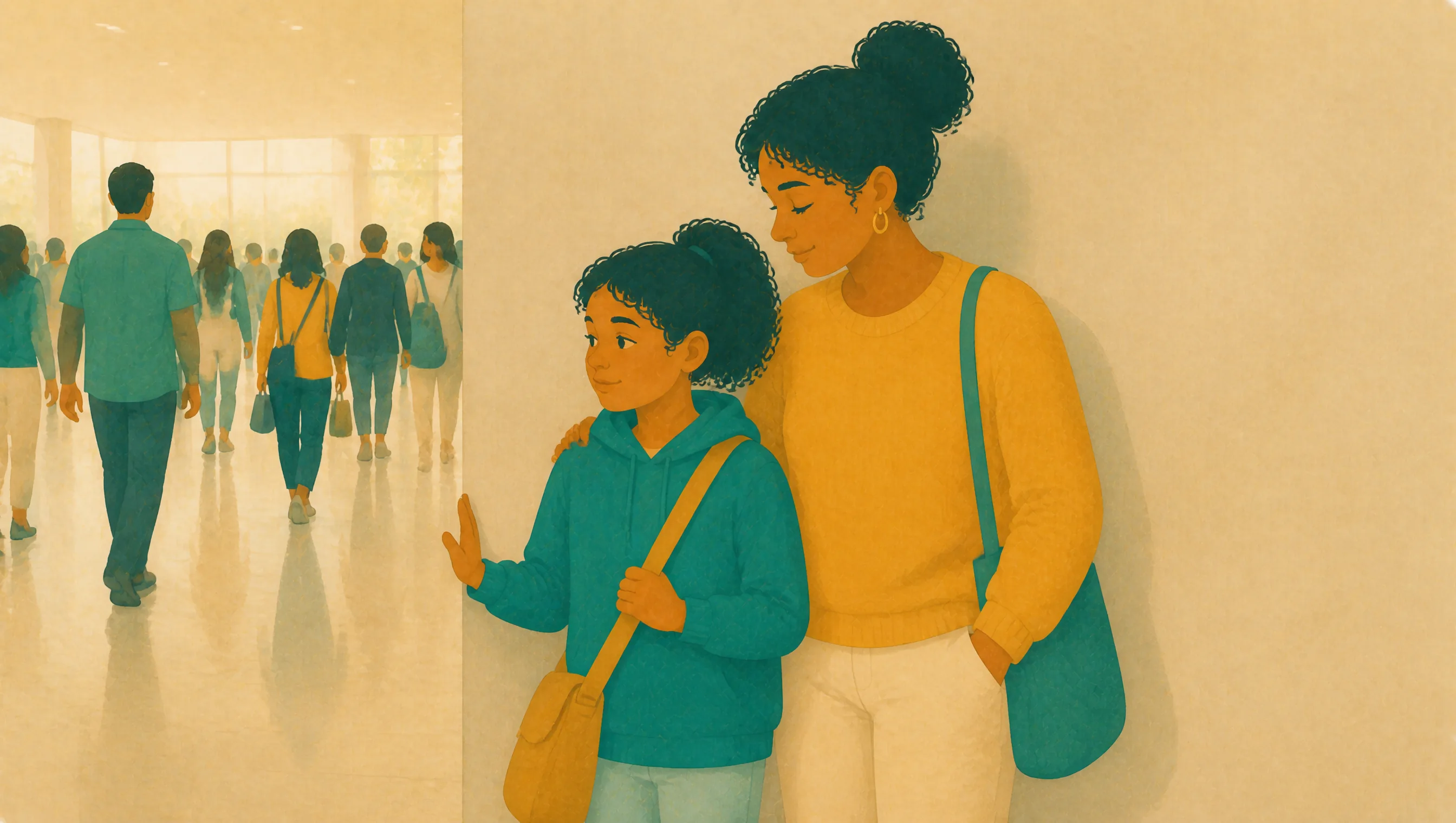
A supermarket can contain bright ceiling panels, reflective floors, moving trolleys, stacked colours, signs, screens and people crossing every direction. A child who looks down or covers their eyes may be reducing input, avoiding glare, trying to navigate or responding to pain.
Find the visual problem before deciding what the behaviour means.
Separate the demands
Visual difficulty may involve:
- brightness or glare;
- flicker;
- contrast;
- stripes, repeating patterns or crowded print;
- many objects competing for attention;
- movement at the edge of vision;
- finding one item among many;
- judging steps, distance or speed; or
- combining vision with balance and movement.
Berkshire Healthcare NHS describes possible visual over-responsiveness through light sensitivity, distraction, looking down and difficulty in visually busy settings [1]. Those observations are not a diagnosis. The same action may relate to eyesight, migraine, anxiety, balance, fatigue or uncertainty.
Check eyes and health
Children may not realise that their vision differs from other people's. NHS guidance recommends an optician or GP review whenever there are concerns and notes possible signs including headaches, eye strain, holding books close, losing place, coordination difficulty and eye rubbing [3]. Children can be tested even if they cannot read or speak.
Notice:
- new squinting or closing one eye;
- red, painful or watering eyes;
- change in reading distance or place keeping;
- headaches, nausea or dizziness;
- bumping into objects or missing steps;
- flashing, blurring or another change in vision; and
- whether light sensitivity began suddenly.
Eye pain, sensitivity to light, altered vision or a markedly red eye may need urgent advice [4]. Severe headache, vomiting or neurological change also needs the appropriate urgent route. Do not wait for a sensory strategy to work first.
Map one busy place
Walk through the sequence:
| Stage | Possible visual demand |
|---|---|
| entrance | change from daylight to bright artificial light |
| aisle | long patterns, signs and moving trolleys |
| search | one product among many similar packages |
| queue | screens, people crossing and little control over distance |
| exit | glare, doors and traffic movement |
Ask the child which part is worst. They may point to the lights, say everything moves, report eye pain or show that finding the product is the barrier.
Then change one part: visit at a quieter time, use a shorter list with pictures, enter by a less reflective route, pause beside a plain wall or let one adult search while the child waits in a lower-load place.
Reduce visual competition
At home or school, try:
- a plain work surface;
- only the materials needed for the current step;
- storage labels with clear contrast;
- a divider or seat away from moving corridors;
- softer or different lighting where safe;
- blinds or position changes to reduce glare;
- uncluttered backgrounds behind objects or text; and
- one visual instruction rather than a wall of prompts.
Moorfields Eye Hospital explains that contrast and plain backgrounds can make objects easier to locate, especially for children with visual impairment [2]. The source is not evidence that every child who prefers a plain surface has impaired vision. It shows why the environment matters.
Berkshire NHS suggests lower-stimulation work areas and changes to seating or light as options [1]. Review the activity rather than the appearance of the room. Did the child find the page, remain in the space or move more safely?
Make visual support easier to find
A visual timetable can become part of the clutter when it contains the whole week, decorative borders, several symbol styles and old information. Show the amount the child can use.
That may mean one card for the current action, two steps on a strip, a photograph of the destination or a plain written list. Remove completed information if seeing it no longer helps. Keep the location and symbol meaning consistent enough for the child to find without another search.
More colour does not always create clarity. Use contrast to distinguish the item from its background, not to make every item compete. Ask the child to locate the next step rather than asking whether the display looks helpful.
If a child repeatedly misses visual prompts, check placement, size, lighting, sight and whether they understand what the prompt means. Adding a larger wall of symbols will not solve an inaccessible cue.
Use caps and tinted lenses carefully
A peaked cap, visor or sunglasses may reduce overhead light or outdoor glare if the child chooses them. Define the setting and purpose.
Do not assume darker is always better. Tinted lenses can alter contrast, communication and safe navigation. Constantly darkening ordinary indoor spaces may create difficulty elsewhere. An optometrist or relevant eye professional can advise where light sensitivity is persistent, painful or affects much of the day.
The child may prefer to look away, close their eyes briefly or stand at the edge. These can be useful routes, provided they can still receive necessary safety information.
Keep sound and movement separate
Busy places rarely create visual input alone. A child may be coping with announcements, smells, crowd proximity, walking and decisions at the same time.
Test comparisons. Is the empty shop under the same lighting manageable? Is the crowded outdoor market difficult without artificial light? Does a quiet classroom remain visually tiring? These differences help separate sound sensitivity from visual movement and search.
Do not add more verbal instruction while the child is navigating. Use one landmark or next action:
Find the blue wall. We will stop there before the stairs.
Make routes easier to read
In a busy building, finding the destination may be the main visual task. Give one landmark at a time, use a photograph of the entrance or draw a simple route that omits irrelevant detail. Signs high above a crowd may be invisible to a child who is avoiding glare or moving faces.
Choose a waiting point with a plain background and a clear exit where possible. "Stand by the red pillar" is easier to act on than "stay where I can see you". In shops or stations, agree what the child should do if separated and which staff member or fixed place is safe to approach.
Do not assume a child who reads well can find information on a crowded board. Searching, filtering and navigating are different from recognising the words once located.
Make print and screens usable
If reading or screen work causes strain, change presentation while arranging an eye check where needed:
- increase spacing and reduce surrounding clutter;
- show one section at a time;
- adjust brightness and glare;
- use a line guide if the child finds it helpful;
- provide paper or audio alternatives; and
- allow breaks before pain or loss of place.
Do not prescribe coloured overlays, tinted lenses or a particular font from a sensory description alone. Record the exact task, symptom and comparison condition for the optometrist, school or relevant professional.
A useful next step
Choose one place the child avoids. Record light, glare, pattern, movement, visual search, sound and navigation. Ask what their eyes and body notice first.
Change one visual feature or route and compare participation. Arrange an eye test if vision, headaches, strain or coordination may be involved.
The aim is not a permanently dim world. It is a child who can see, move and participate with avoidable visual barriers removed and health concerns assessed.
Sources and further reading
- [1] Berkshire Healthcare NHS Foundation Trust. Visual (sight) system (accessed 4 August 2026).
- [2] Moorfields Eye Hospital NHS Foundation Trust. Visual comfort (accessed 4 August 2026).
- [3] NHS. Eye tests for children (accessed 4 August 2026).
- [4] NHS. Conjunctivitis (accessed 4 August 2026).