
What counts as rest for a child who cannot switch off?
How to recognise and protect forms of rest that reduce demand and effort, even when a child does not look still, silent or conventionally relaxed.
The short answer
Rest does not have to mean sleep, silence or lying still. For a neurodivergent child, useful rest may be a familiar repetitive activity, movement without instruction, time alone, parallel company, drawing, sorting, listening, watching something predictable or returning to a special interest. Judge it by what it asks of the child and what happens afterwards: are decisions, social performance, sensory exposure and adult correction reduced, and does the child emerge no more depleted or distressed? Ask what feels restful, observe rather than impose, and offer a small menu that includes different levels of movement, sound and company. Protect the break from questions, chores and disguised learning. Rest should not be used to remove every valued activity or isolate a child indefinitely. Persistent exhaustion, loss of function, pain, severe daytime sleepiness or a major change in energy needs health assessment; a rest plan is not a diagnosis or a substitute for sleep.
- Rest is a reduction in effort and demand, not one required body position.
- Familiar movement, interests or parallel company may be restorative for some children.
- Judge a break by the child’s experience and its after-effect.
- Protect rest from decisions, correction and disguised productivity.
- New or persistent exhaustion needs assessment rather than a larger downtime schedule.
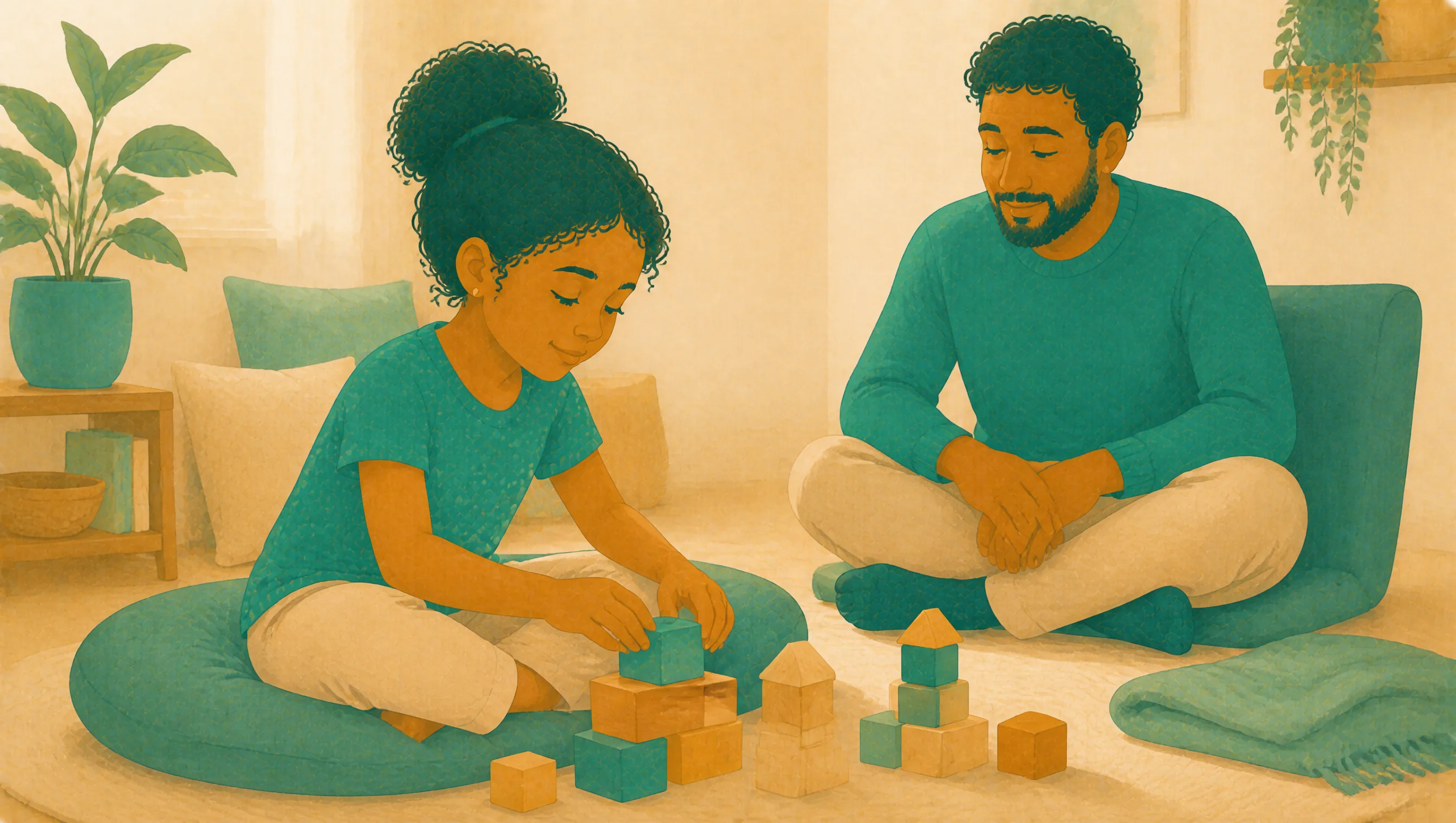
Some children rest by curling under a blanket. Others pace, draw the same character, sort objects, build in a game or listen to one familiar track repeatedly. If an adult insists that rest must look still and quiet, the child may spend the entire break performing relaxation.
Rest is better understood as a reduction in effort. The useful question is not “Does this look restful?” but “What is this activity asking from the child, and what state are they in afterwards?”
The child's own answer should carry real weight here.
Separate rest from sleep
Sleep is a biological state. Rest is a period in which physical, sensory, cognitive, emotional or social effort is reduced. Rest cannot replace needed sleep, and a rest plan cannot treat a sleep disorder. It can create recovery space within the day.
A child may need rest because school required sustained attention, masking, noise tolerance, movement control, language processing and rapid transitions. Another may be physically tired from mobility, pain or poor sleep. The form of rest should match the load.
Rest can be active in one sense and low-demand in another. Repeating a known Lego build uses the hands but may remove novelty, language and social judgement. Walking the same short route uses the body but may reduce indoor noise and decision-making. The activity name does not tell you its cost; the conditions around it do.
If the child is persistently exhausted, falling asleep in the day, losing function or showing a major change in energy, seek health assessment. Do not explain every form of fatigue as “neurodivergent burnout”.
Ask which kind of effort needs to stop
Consider five kinds of load:
- Social: conversation, eye contact, interpreting others, sharing space or being watched.
- Cognitive: instructions, choices, planning, schoolwork and switching attention.
- Sensory: noise, light, touch, smell, crowds or internal discomfort.
- Emotional: holding feelings in, uncertainty, conflict or anticipating the next demand.
- Physical: movement, posture, pain, coordination, hunger or illness.
The same activity can reduce one load and increase another. A walk removes conversation for one child and adds painful movement for another. Gaming removes social ambiguity in one setting and brings intense competition in another. Silence soothes one person and makes internal noise louder for someone else.
Ask a concrete question: “Do you want fewer sounds, fewer people, fewer decisions or less movement?” Pictures or a short menu may help. When the child cannot answer, compare what they choose freely and how they seem afterwards.
Look for the after-effect
Do not judge only the minutes inside the break. Notice whether the child emerges:
- more able to communicate;
- less physically tense or distressed;
- no more depleted than before;
- able to begin one necessary next step with support;
- clearer about what they need;
- or, conversely, more agitated, stuck, sore or overwhelmed.
Rest does not have to make a child cheerful or ready for demands. Sometimes it prevents further depletion. A break may be helpful even when the child still needs the rest of the evening reduced.
Avoid using immediate compliance as the measure. “They did homework afterwards” does not prove the break restored them; it may show they pushed through. Ask about internal effort as well as visible output.
Build a small rest menu
Offer a few familiar options rather than asking an exhausted child to invent one. Include different kinds of input:
- lying or sitting somewhere comfortable;
- repetitive drawing, sorting, crafting or building;
- a familiar programme, audiobook or music;
- gentle pacing, rocking, swinging or stretching where safe;
- time with a focused interest;
- parallel company with no requirement to speak;
- being alone with a clear end signal;
- a snack, drink, toilet or temperature adjustment before settling.
Focused interests may provide predictability, competence and relief from social uncertainty. They are not automatically rest: a pressured research task, competitive game or activity that cannot be stopped may add load. Understand the role of focused interests without either banning or romanticising them.
Make “nothing from the menu” a possible answer. Sometimes the child already knows what they need.
Remove hidden demands
A break stops being a break when an adult repeatedly asks whether it is working, suggests improvements, gives instructions from the doorway or turns the activity into learning.
During an agreed rest period:
- postpone non-urgent questions;
- do not correct posture, tone or harmless movement;
- avoid surprise chores;
- reduce choices to those the child requested;
- make the end predictable;
- write down anything the adult needs to remember instead of interrupting.
“You can rest, but first tell me everything that happened” asks for processing before recovery. Collect only urgent information and return later.
If safety monitoring is needed, make it as unobtrusive and predictable as possible. Agree whether the door remains open, when an adult checks and how the child can ask for help.
Include movement when movement reduces effort
Stillness can require active control. A child who has contained movement all day may find slow repetitive movement less effortful than sitting upright on a sofa. Let rest include pacing, rocking, bouncing gently, walking or another safe familiar pattern when the child experiences it as regulating.
Do not prescribe exercise as a universal route to calm. Intensity, pain, coordination, temperature and transition cost matter. The test is whether the chosen movement reduces load and remains safe, not whether it looks healthy to an observer.
Paediatric occupational-therapy services may support pacing, fatigue management, relaxation and adaptations where those needs sit within the service’s remit.1 Access and referral routes vary, and ordinary family rest does not require a professional programme.
Decide about screens by function
A screen may provide predictable sound, controlled social contact, a focused interest or an escape from a noisy room. It may also add rapid stimulation, upsetting content, physical discomfort, lost time or an extremely hard transition.
Instead of “screens are not rest”, ask:
- What is the child doing on the screen?
- Is it chosen or compulsive-feeling?
- Does it reduce or increase interaction demands?
- What happens when it stops?
- How is the child afterwards?
A familiar downloaded programme may be restorative where competitive play is not. Audio may retain the helpful content with less visual input. A clear stopping cue and a next step can protect the transition without pretending the device has one effect on every child.
Put rest before complete collapse
Rest offered only after a meltdown becomes associated with crisis. Look for predictable pressure points: arriving home, after personal care, before homework, following travel or between social events. Place a short protected interval before the child has to prove they cannot continue.
Design the first hour after school around the actual recovery need. On high-load days, reduce later expectations as well. Twenty minutes cannot compensate for an evening that remains inaccessible.
Keep a hard-day version. It may involve fewer transitions, food in the easiest acceptable form, less conversation and help with tasks the child usually manages. Adjust support to current capacity rather than withholding it to protect independence.
Protect rest without shrinking life
Rest should support access to valued life, not quietly replace it. If a child gives up friends, school, clubs or interests because every available hour is recovery, the overall demand and health picture need attention.
Ask what the child wants energy for. Then protect capacity around that priority. This may mean declining a lower-value demand, changing transport, reducing unnecessary waiting or spacing activities rather than removing the meaningful activity first.
NICE recommends considering individual sensory sensitivities and adapting environments and processes for autistic children and young people.2 That principle supports reducing avoidable load; it does not promise that one adjustment will restore energy.
Run a simple rest experiment
Choose one predictable point in the day and one or two options. Agree a start, an approximate end and what will not happen during the break. For a week, note the child’s state before and after in ordinary words.
Ask:
- Was the activity genuinely chosen?
- Which effort reduced?
- What interrupted the break?
- Did the child need longer, shorter or a different kind of rest?
- Was the next demand itself too large?
Keep the arrangement flexible. A child may want company one day and solitude the next. Consistency means the right to recovery is dependable, not that the same activity is compulsory.
Tell other adults what you have learned in functional language: “After school, please offer food and twenty minutes without questions; drawing or pacing are both rest.” This is clearer than “needs downtime” and less likely to be replaced by a well-meant quiz about the day. At school or a club, the equivalent may be a quiet arrival, reduced conversation, a predictable low-demand task or permission to step out briefly.
Research on sleep interventions in children with neurodevelopmental and medical conditions is varied and does not support promising that one relaxation or routine strategy will solve sleep.3 Daytime rest should be presented with the same honesty: it is an individual support to test, not a cure.
Rest counts when the child no longer has to spend the break meeting someone else’s picture of calm. Find what reduces effort, protect it from hidden demands and stay curious about persistent exhaustion that needs more than downtime.
Footnotes
-
Oxford University Hospitals describes paediatric occupational-therapy work that can include pacing for fatigue, adaptations, sleep techniques and relaxation within relevant clinical pathways. ↩
-
NICE CG170 recommends considering individual sensory sensitivities and adapting physical environments and care processes for autistic children and young people. ↩
-
A 2025 systematic review of behavioural sleep interventions in paediatric neurodevelopmental and medical populations found heterogeneous approaches and limited evidence about maintained effects. ↩
Sources and further reading
- [1] NICE. Autism spectrum disorder in under 19s: support and management. 2013; last updated June 2021; reviewed September 2025 (accessed 4 August 2026).
- [2] Oxford University Hospitals NHS Foundation Trust. Paediatric occupational therapy. Current service information (accessed 4 August 2026).
- [3] Kamara and colleagues. Systematic review and meta-analysis of behavioral interventions for sleep disruption in pediatric neurodevelopmental and medical conditions. 2025 (accessed 4 August 2026).