
How much should I still be doing for my child at this age?
A practical way to decide which daily-living support to keep, teach, share or reduce without using age alone as the test.
The short answer
Use the real task, not the child's age or a comparison with siblings, to decide how much help remains appropriate. Map what the task requires: noticing, starting, sequencing, language, sensory and motor access, materials, time, checking and safety. Then separate what the child can do reliably, what they can do with a tool or person, what is being taught and what an adult still owns. Reduce one support function at a time and watch whether access, accuracy, distress and recovery remain acceptable across ordinary hard days. Independence can include a checklist, adapted equipment, automation or asking another person for help. Keep adult control where the consequence of error is high, such as medication or road safety, while giving the child meaningful information and choice. If help is sustainable and enables participation, its continued presence is not proof that anyone has failed.
- Decide from the demands and consequences of the real task, not age alone.
- Make tools, prompts, preparation and checking visible as parts of current support.
- Reduce one support function at a time and test reliability on ordinary hard days.
- Keep appropriate adult responsibility for high-consequence health and safety tasks.
- Define independence as reliable participation and growing agency, not doing everything unaided.
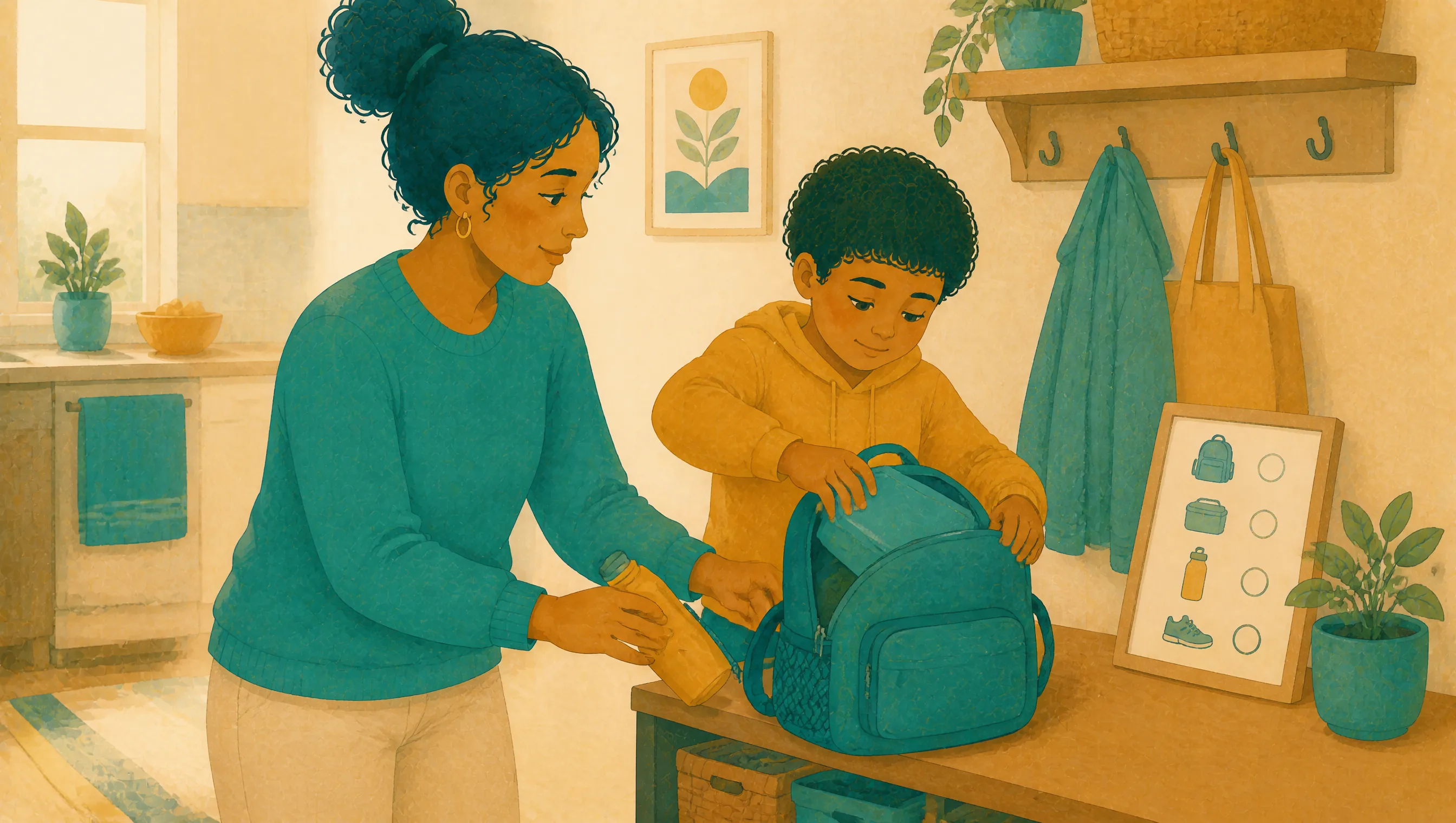
A parent still lays out clothes, checks the school bag and stands nearby during toothbrushing. Somebody remarks that the child is old enough to do those things alone. The parent begins to wonder whether support is helping or holding the child back.
Age matters, but it does not perform the task. The useful question is which functions the child can currently manage, which support makes participation possible and what consequence follows if a step fails.
Start with one real task
Choose a recurring task that matters to the child or household: getting dressed, making a snack, showering, packing for school, managing laundry or preparing for an activity.
Define a sufficient finish. “Be independent with dressing” is too broad. “Choose weather-appropriate clothes from the prepared drawer, dress and put night clothes in the basket by 7.45” can be observed and changed.
Avoid choosing the task that causes adults the most embarrassment. A skill is worth working on when it improves the child's health, access, privacy, participation or control, not because another family expects it.
Map the whole demand
Walk through what actually happens. Mark whether the task requires the child to:
- notice that it is time;
- leave another activity;
- understand the goal;
- choose between options;
- find and handle materials;
- remember and sequence steps;
- tolerate sensory input;
- use language, motor or coordination skills;
- estimate time;
- detect an error;
- ask for help;
- judge safety;
- recognise that the task is finished.
Include the adult's hidden contribution. If a parent checks the weather, washes acceptable clothes, opens stiff packaging, reminds twice and inspects the outcome, those are current parts of the system.
Removing the parent without relocating those functions does not create independence. It creates a task with missing infrastructure.
The guide to breaking one task into observable actions can help when the sequence is still too vague.
Sort support into four honest groups
For each function, decide whether it is:
- Owned by the child: completed reliably enough without another person's action.
- Supported: completed using a tool, adaptation, prompt, prepared environment or another person.
- Being learned: practised deliberately with enough help to prevent repeated failure.
- Adult-owned: retained by an adult because the skill is inaccessible, the consequence is high or the child has not agreed to take it on.
A child may independently put clothes on while an adult still selects suitable options. They may set a medicine reminder while an adult stores, dispenses and verifies the dose. Describe that accurately.
NHS guidance notes that autistic children vary widely: some need little support and others need daily help, with needs changing over time and between situations [1]. A diagnosis does not provide a standard independence timetable.
Use consequence to set the level of checking
Not every error is an equal learning opportunity.
A mismatched sock may be harmless. Missing life-sustaining medication, crossing a road unsafely or using hot equipment incorrectly can have serious consequences. Adults should retain appropriate supervision and checking while skills develop.
Ask:
- What could happen if this step is missed?
- Would the child recognise the problem?
- Could they recover or seek help?
- Is practice possible in a lower-risk version?
- Who remains responsible in law and in the household?
Risk does not require excluding the child. Explain the safety check, let them participate in accessible portions and show how responsibility may change.
Reduce one support function at a time
Suppose an adult currently says each dressing step, finds clothes and checks the finish. Do not withdraw all three jobs on Monday.
Keep clothes prepared and the final check while replacing spoken sequencing with a short visual strip. When that is reliable, the child might join the evening clothes choice. Later, the adult weather check can become a shared check.
This shows which change helped or failed. It also keeps the task achievable while a new skill is learned.
NICE recommends individualised support that considers communication, sensory factors, development, physical and mental health and the environment [2]. It does not set an age by which a daily-living task should be unaided.
Teach in the real place at the usable time
Practising buttons while already late for school teaches under pressure. Choose a settled period, use the actual clothing and make the practice smaller.
The first goal might be aligning one button, checking one label or opening the snack container. Demonstrate, practise and provide enough help for a successful finish. Return to the ordinary support when capacity is low.
Generalisation is not automatic. A child who makes toast in a familiar kitchen may not find equipment or judge settings elsewhere. Practise variations deliberately and keep the safety support.
Parent-implemented autism interventions vary widely. A meta-analysis reported smaller average effects for adaptive behaviour and life skills than for several other outcome areas, and lower-bias studies produced lower estimates overall [3]. This does not show that a parent can teach any daily skill through one method; it supports modest claims and individual review.
Let tools count
Adults use calendars, labels, satnav, direct debits, recipes and other people. A child does not have to abandon equivalent support to qualify as independent.
Useful tools may include:
- clothes organised by complete outfit or type;
- adapted fastenings or equipment;
- a photograph of sufficient finish;
- a checklist, timer or audio prompt;
- pre-portioned materials;
- an agreed adult check;
- a phone reminder or automation;
- a communication card for asking for help.
The external-brain guide shows how to make these supports retrievable rather than dependent on an adult remembering to offer them.
Protect privacy and dignity
As children grow, the manner of help matters. Ask before entering bedrooms or bathrooms, use the least intrusive supervision that remains safe and give private ways to request assistance.
A teenager may accept a checklist but reject a parent calling instructions through the door. A younger child may want the same adult each time. Personal care may require sensitive, specialist planning where communication, continence, menstruation, pain or safeguarding is involved.
Do not discuss the child's skills publicly as a lesson or joke. Support can be visible to the people who need to provide it without becoming family entertainment.
Distinguish capacity from availability
A child may possess a skill and be unable to use it after school, during illness or under time pressure. That variation is information, not proof they are manipulating adults.
Keep a hard-day version. More direct help today does not erase learning. It protects the task, relationship and capacity to try again.
The article on the gap between knowing and doing explains why understanding and performance can separate under different conditions.
Do not use siblings as the measuring tool
Siblings may reach the same household task through different routes and at different times. One child may safely make food but need help to remember a bag; another may manage the bag but need supervision around heat and knives.
Keep household expectations fair in purpose, not identical in form. Each person can contribute according to access and capacity. Explain that support is private and individual rather than inviting siblings to judge whether someone receives too much help.
Watch for responsibility drifting onto a brother or sister. A sibling can share a routine or help by choice, but should not become the medicine checker, personal-care assistant or person blamed when another child is late.
Respond when a skill appears to go backwards
A task that was once manageable may require more help after illness, school transition, puberty, medication change, bereavement, poor sleep or a rise in demands. Restore enough support first, then investigate.
Check whether the task itself changed. Larger clothes may have different fastenings. Secondary-school packing may involve a rotating timetable and several rooms. A shower may become more sensory or socially complicated during puberty. What looks like lost skill can be a larger job.
Avoid making help conditional on proving why capacity changed. Record the pattern, check health and emotional concerns, and rebuild from the last reliably accessible point. If the loss is sudden, substantial or affects several areas, seek appropriate professional advice.
Support can also increase temporarily while a new tool is learned. A parent may spend more time teaching a phone reminder than they previously spent calling upstairs. Judge the arrangement after it has had a fair trial, while keeping an exit route if it is adding distress.
Make adult rescue visible
Some families appear to have an independent child because an adult quietly prevents every failure: replacing forgotten kit, completing forms, cleaning unfinished tasks and messaging apologies. This may protect the child appropriately, but it hides the current level of support from everyone, including the parent carrying it.
Name each rescue and decide whether to keep it, teach part of it, automate it or share it. Do not expose the child to a costly consequence merely to reveal the work. The aim is accurate planning, not a lesson through failure.
Include the child's priorities
Ask what the child wants to do with less help and why. Privacy in personal care, making a preferred food or travelling to a friend may matter more to them than a perfectly organised bedroom.
Offer real influence over method, timing and support. A child can say that one goal feels exposing or unimportant. Adults may still require household contribution or safety learning, but the route should not erase the child's view.
For adolescence, the guide to daily-living independence and adulthood expands the method across money, travel and community tasks.
Review reliability, not one performance
Test the changed support for two ordinary weeks. Record:
- whether the child noticed and began;
- accuracy and safety;
- tools and prompts used;
- time and recovery;
- distress or conflict;
- whether help was requested;
- whether the family could maintain the arrangement.
One successful attempt on a calm Saturday does not prove support can disappear on a school morning. One hard day does not prove the skill is absent.
Progress may mean owning one more function, choosing a tool, asking earlier for help or completing the task with stable support. The right amount to do for a child is the amount that keeps the task accessible and safe while preserving genuine opportunities for skill, participation and growing control.
Sources and further reading
- [1] NHS. Supporting an autistic child. Page last reviewed May 2026 (accessed 4 August 2026).
- [2] NICE. Autism spectrum disorder in under 19s: support and management. 2013; last updated June 2021 (accessed 4 August 2026).
- [3] Deb and colleagues. The effects of parent-implemented interventions on outcomes of children with autism: a meta-analysis. 2022 (accessed 4 August 2026).
