
Why do noise and mess at home affect me so much?
Work out whether sound, visual load, interruption, unfinished decisions or lack of control is using your capacity, then change the environment.
The short answer
Noise and mess are not single inputs. Sound may be loud, sudden, layered, repetitive or impossible to control. Mess may create visual load, hide essential objects, represent unfinished decisions or block a space you need to use. Notice the exact moment your capacity changes: which sound, room, time, task and competing demand are present. Then reduce the input at its source where possible. Separate simultaneous sounds, move noisy activities, close a door, use ear protection that preserves necessary supervision, create one visually quieter surface and give high-use items a point-of-use home. Do not make a child responsible for managing an adult's sensory system, but do include adult access needs in the household design. A diagnosis is not required before changing an environment that is not working. Seek health advice for new or worsening sound sensitivity, pain, hearing change, headaches or other symptoms. If sensory overload is part of a wider possibility of autism or ADHD, record the lifelong pattern and effect across settings rather than treating one difficult home period as proof.
- Separate volume, unpredictability, layering, repetition and lack of control.
- Treat clutter as visual input, lost access and unfinished decisions rather than a moral failure.
- Change the source, timing and space before relying only on personal tolerance.
- Keep adult sensory access visible without making children responsible for regulating the adult.
- Seek health advice for new, painful or worsening sensory changes.
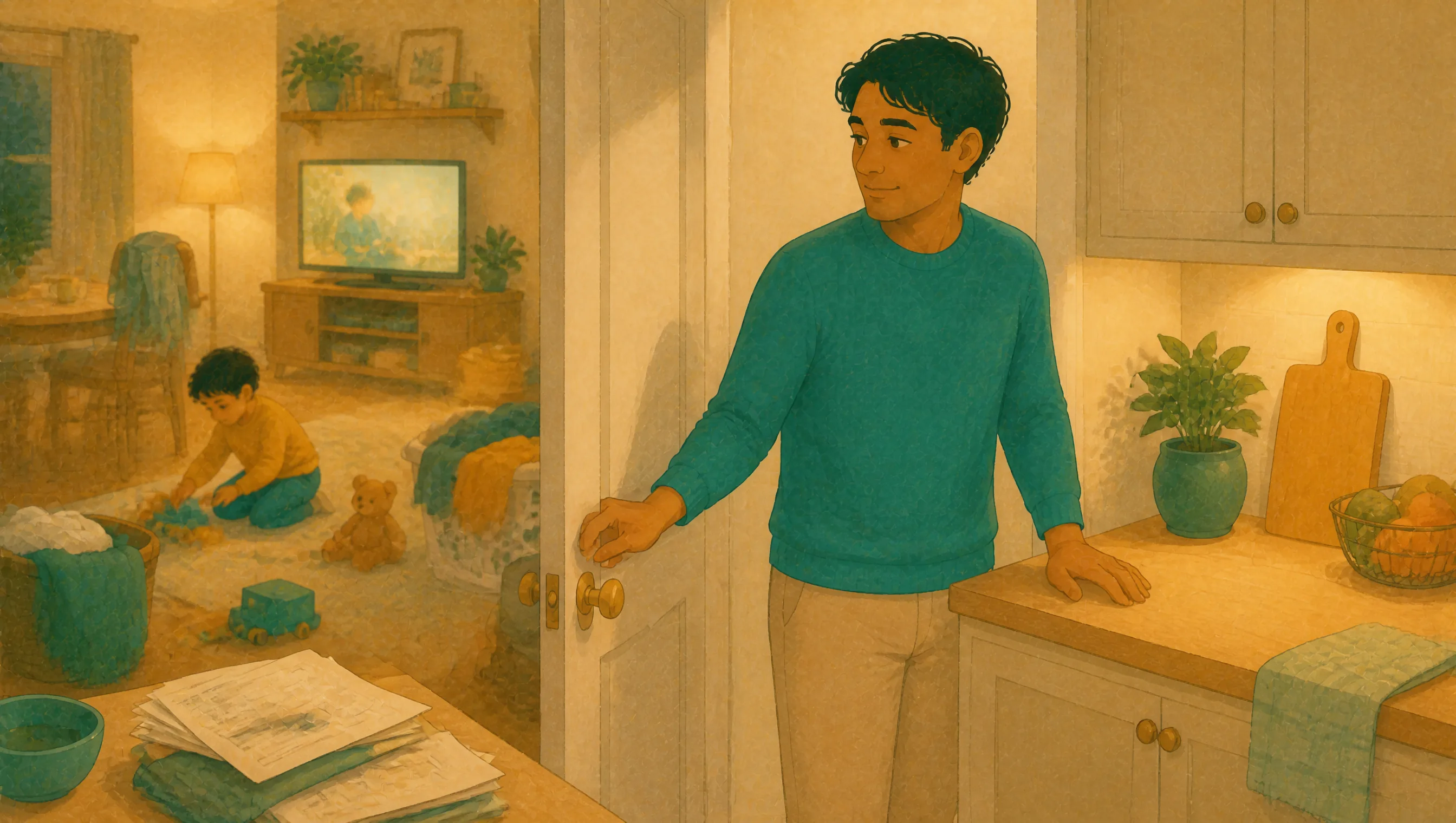
A noisy, untidy home can feel like several tasks entering your body at once. The television is on, a child repeats a sound, another person asks a question, objects cover the table and the item you need has disappeared underneath them. Somebody says, "Just ignore it," but none of it has become ignorable.
The useful question is not whether you should cope better. It is which features are using your capacity and what the household can change.
Noise is more than volume
Sound may become hard because it is:
- loud;
- sudden or unpredictable;
- high-pitched or low and vibrating;
- repeated without a known finish;
- layered with other sound;
- carrying language you must process;
- linked to possible danger; or
- outside your control.
A moderate sound may be manageable alone and impossible while you cook, supervise the stairs and answer a school message. Record the whole moment rather than deciding that one person is too noisy.
Try:
"At 5.20, the extractor, television and two conversations were happening while I checked medication. I lost track of the dose and had to begin again."
That identifies a safety-critical task and simultaneous sound. It supports a rule that medication is prepared with one adult, no conversation and the television paused.
Mess carries several kinds of load
"Mess" might mean:
- too many colours, shapes and objects in view;
- losing an essential item;
- blocked access to a chair, worktop or exit;
- several unfinished tasks demanding decisions;
- food, liquid, sharp objects or medication creating a hazard;
- possessions being used without consent; or
- a social judgment about what a home should look like.
Separate these. A pile of clean washing on a safe chair is visually busy but not the same problem as medication within reach or the only food-preparation surface being unusable.
Choose the function the space must provide. The kitchen needs one safe place to prepare food. The hall needs a clear exit. A parent may need one surface where paperwork and keys remain findable. Make those areas usable before attempting the whole house.
Observe the capacity change
For three or four difficult moments, note:
- place and time;
- sound sources;
- what is visible or blocking access;
- the task you were trying to do;
- interruption and language load;
- hunger, sleep, pain and stress;
- the first sign in your body or behaviour; and
- what reduced the pressure.
Do not turn the record into a score of which child caused most distress. It is an environmental map.
NHS stress guidance describes possible physical, emotional and behavioural changes and notes that family, caring, work, health and financial pressure can contribute.1 That does not establish that stress is the cause. It keeps the broader load visible when sensitivity changes with capacity.
Reduce sound at the source
Before asking yourself to tolerate more, try:
- turning off sound nobody is using;
- separating television, music and conversation;
- moving a blender, hairdryer or gaming device behind a door;
- warning before a necessary sudden sound;
- giving a repeated noisy activity a place and time;
- using subtitles and lower volume;
- adding soft furnishings or door seals where practical; and
- arranging one low-input period during a predictable pressure point.
Noise reduction should not make a child disappear. A child may need vocal play, movement, music or a device. Find where and when it can happen with less collision, or let people use separate spaces for part of the activity.
If the child's sound is communication or regulation, do not make quietness the only acceptable outcome. Look for the feature adults can change around it: close the kitchen door, move a competing conversation, pause background media, offer an outdoor or larger space, or use sound protection. Some sounds cannot be scheduled neatly. The family plan still needs an adult route for stepping back without withdrawing necessary care.
Tell the child what is happening without making your pain their fault:
"That sound helps you move through the game. My ears need less sound at the same time. You can keep playing here with the door closed, and I will be in the next room where I can still hear if you call."
The mixed-neurodivergent-household guide helps design around sensory needs that collide without deciding that the quieter person automatically wins.
Use personal protection with supervision in mind
Earplugs, ear defenders or noise-reducing headphones may help. Choose a level that still allows you to hear a child, alarm, timer, traffic or other necessary safety information. One ear uncovered or a lower attenuation option may be more suitable during supervision.
Do not insist that a tool must be worn all day because it helped once. Pressure, heat, internal body sounds or loss of communication may create other problems.
NICE adult-autism guidance specifically includes reducing noise and considering ear protection as possible environmental adaptation for autistic adults in care settings.2 That is autism-specific clinical guidance, not proof that ear defenders suit every parent or situation.
Create one visually quieter field
You do not need an organised house before obtaining visual relief.
Choose one:
- clear the area directly around a safety task;
- use an opaque box for items awaiting decisions;
- give daily objects one open point-of-use home;
- cover a crowded shelf;
- keep one wall or corner relatively plain;
- move paperwork into one visible tray; or
- photograph a complicated setup so it can be restored without remembering.
Do not create an elaborate storage system that needs constant sorting. A broad basket that contains the items may be more usable than twelve labelled categories.
Set a boundary around shared surfaces:
"The left half of the table stays clear for food and medication. Projects can remain on the right tray."
This protects function without demanding an immaculate room.
Also review who creates the categories and who restores them. A parent may spend an hour assigning every toy a labelled location, while the child and other adults use broad piles. The system then turns one person's visual need into permanent unpaid sorting work for the same person.
Use the least detailed category that keeps the space functional: building toys, art, clothes to wash, paperwork to answer. Give other adults ownership of a whole area, including deciding where its ordinary objects live. If nobody can maintain a category, widen it or remove it.
For objects belonging to children, distinguish containment from disposal. A clear floor does not give adults permission to discard valued possessions without involvement. Use a holding box and a later decision when immediate visual relief is needed.
Put adult needs into the family plan
Parents sometimes describe children's sensory needs in detail and their own as a temper problem. State your access need without making the child responsible for it.
Useful adult responsibility:
"I cannot safely answer questions while measuring medicine. I will close the door and come back in three minutes."
Responsibility placed on the child:
"You know noise makes me angry, so it will be your fault if I shout."
Adults set the environment, seek help and take responsibility for their behaviour. Children can follow age-appropriate household agreements, but they do not become monitors of an adult nervous system.
Consider whether this is part of a wider pattern
The NHS includes marked sensitivity or low sensitivity to light, sounds, smells, tastes or textures among possible signs of autism in adults.3 One period of noise intolerance does not establish autism. Adult autism assessment considers a broader developmental pattern and current functioning.
ADHD, migraine, hearing conditions, anxiety, trauma, sleep loss, pain and other factors may also be relevant. Do not diagnose from a sensory preference. Record lifelong patterns, different settings, masking, routines, communication, attention and the effect on daily life if you want to discuss assessment.
The article on being autistic or having ADHD as a parent covers assessment and practical support without requiring a label before you use accessible systems.
Look for new or medical changes
Seek health advice if sound sensitivity is new, worsening, painful or accompanied by hearing loss, ringing, dizziness, severe headaches, ear symptoms or another physical change. Mention medication changes, sleep and recent illness.
If the main change is that every ordinary input has become intolerable alongside persistent exhaustion, low mood or anxiety, describe the whole pattern to a GP. Do not reduce it to housekeeping.
If you are repeatedly becoming frightened by your own anger, shouting, threatening or breaking things in response to sensory load, seek help for that behaviour as well as changing the environment. Sensory pain can be relevant and the child still needs protection from an adult response that frightens them.
Review access, not tidiness
After changing one pressure point, ask:
- Could you complete the safety or care task?
- Did people retain access to valued activity?
- Was less sound layered at once?
- Could you find the essential item?
- Did your response become less urgent or frightening?
- Is the arrangement simple enough to maintain?
The goal is not a silent or display-ready home. It is a home in which sound, objects and adult capacity can coexist without repeatedly pushing somebody beyond what they can safely manage.
Footnotes
-
NHS stress guidance describes possible contributors and symptoms, not the cause of an individual's sensory experience. ↩
-
NICE CG142 recommendations on sensory environment apply to autistic adults in health and social-care contexts. They support environmental adaptation but do not prescribe a home arrangement for every parent. ↩
-
NHS adult-autism information lists sensory differences among possible signs. It does not support diagnosis from sensory sensitivity alone. ↩
Sources and further reading
- [1] NICE. Autism spectrum disorder in adults: diagnosis and management. CG142. June 2012, updated June 2021 (accessed 4 August 2026).
- [2] NHS. Signs of autism in adults. Page reviewed May 2026 (accessed 4 August 2026).
- [3] NHS. Get help with stress. Page reviewed March 2026 (accessed 4 August 2026).