
Why do our home systems stop working after the first week?
Why a promising checklist, routine or home station fades, and how to repair the smallest failed part instead of starting over.
The short answer
A system can appear to work while novelty, extra adult attention and unusually careful setup are carrying it. It then fails when the cue blends into the background, information becomes outdated, materials migrate, the adult cannot maintain it or the child's needs and schedule change. Do not treat fading as proof that the child stopped trying. Reconstruct one failed occasion: Was the cue noticed? Was the next action clear? Were the materials present? Could the child act at that time? Was completion visible? Keep the part that still works, repair one point and test again on ordinary days. Give somebody explicit responsibility for resetting or updating the system. A sustainable support may be simpler and include continuing adult help.
- First-week success may include novelty, extra attention and unusually complete setup.
- A system has maintenance work; name who updates, resets and replaces its parts.
- Reconstruct one real failure rather than judging the whole child or system.
- Keep working components and change one variable at a time.
- Review fit after timetable, capacity, age, privacy or task demands change.
- Sustainability on a difficult ordinary day matters more than a perfect launch.
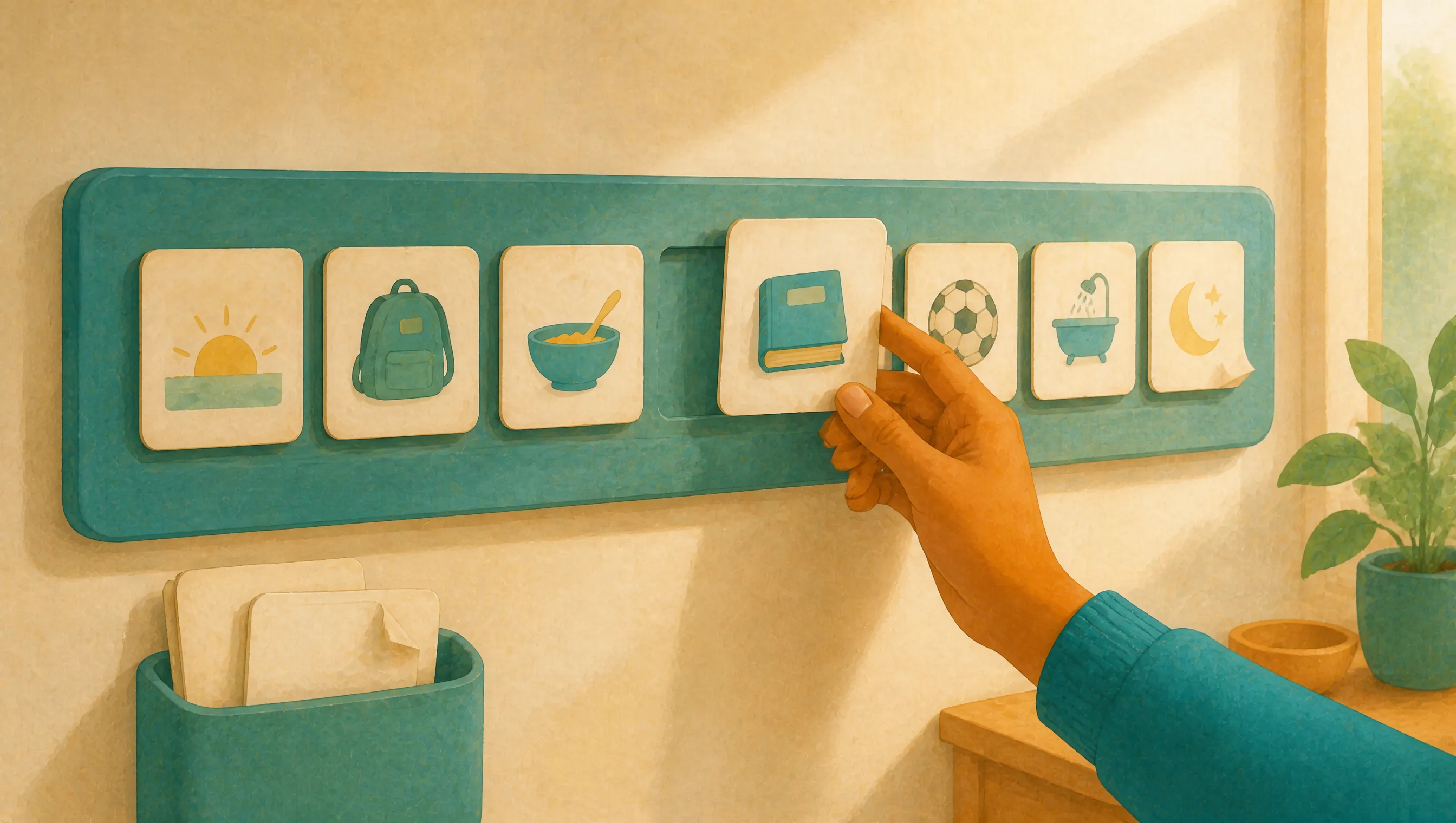
On Sunday, the family creates a morning board. Clothes are ready, cards are crisp and everybody follows the sequence. By the following Friday, two cards are missing, the socks have moved and a parent is calling each step from the stairs.
The usual verdict is that the child lost interest or the family “cannot stick to anything”. A more useful conclusion is that the launch conditions ended. Now you can see what the system needs in ordinary life.
First-week success can hide extra support
A new system often arrives with:
- novelty that makes it easy to notice;
- an adult explaining and pointing to each step;
- materials prepared unusually carefully;
- a calmer day chosen for practice;
- enthusiasm about the hoped-for change;
- more praise or immediate feedback than will continue;
- no timetable disruption yet.
None of that makes the first success false. It means the system was tested with additional supports. Identify them before expecting the same result without them.
If a parent laid out every item and stayed beside the child, record “completed with materials prepared and adult present”. That is accurate evidence. It also tells you what must remain, change or be transferred.
Reconstruct one failed occasion
Avoid “It never works now”. Choose the most recent example and follow the route:
- Cue: What was meant to signal the start? Did the child notice and understand it?
- Availability: Could they switch at that moment, or were they asleep, distressed, absorbed or elsewhere?
- First action: Was it visible and physically possible?
- Materials: Were the right objects in the expected place?
- Sequence: Could the child find what came next?
- Time: Was there enough time for the real task?
- Check: Could they detect what was missing?
- Finish: Did the system show when the job was sufficiently complete?
- Maintenance: Had somebody updated or reset the support?
Stop at the first failure. Everything after it may be a consequence. A child cannot tick “put lunch in bag” if the lunch was not made, and adding a reward for ticking will not produce it.
Check whether the cue became part of the background
Humans notice change. A card in the same position for weeks can become visual furniture, especially when it is surrounded by notices.
Do not respond by making every cue brighter. Reduce competition first. Remove old charts, completed event notices and duplicate lists. Keep one current signal in a consistent usable place.
A cue can be stable without being static. The bag itself might move to an agreed “needs packing” position. A current card can face out while finished cards disappear. A digital reminder can open the action instead of producing another dismissible notification.
Ask whether the child notices the cue before assuming they choose to ignore it. Then check whether noticing leads anywhere. “Morning routine” on a phone may be visible and still fail to identify the next step.
Find the maintenance work
Every external system has an operator. Somebody must:
- replace lost cards;
- update changing school days;
- charge the device;
- return the pen;
- wash the kit;
- clear completed items;
- restock medication or supplies;
- notice that the routine itself has changed.
Write the maintenance jobs down and assign them. The child can take some where appropriate, but do not hide adult responsibilities inside “independence”. A parent may own the weekly school-app transfer while a teenager owns checking the resulting list.
Choose a reset point: Sunday evening, after the task, or when supplies reach an agreed level. Link it to an existing event rather than hoping somebody remembers to remember.
Make the cost of maintenance visible too. A colour printer, subscription app or supply of replacement symbols may not be sustainable. Use ordinary paper, a whiteboard, objects or an existing calendar when they carry the information just as well. A low-cost system that survives is more supportive than a polished one the family cannot replenish. If school created the format, ask for an editable or reusable copy rather than rebuilding it from photographs.
Keep the part that still works
If the child notices the alarm but cannot find the worksheet, keep the alarm and repair material storage. If the sequence works after an adult points to it, investigate how to cue looking rather than redesigning every card.
Changing one variable gives you information. You might alter:
- location;
- timing;
- amount of visible information;
- representation;
- first action;
- material placement;
- adult presence;
- way completion is marked.
Test the repair over several comparable attempts. A new planner, app, colour code and reward introduced together may produce another energetic week without revealing which part helped.
Ask whether the task changed
A system built for last term may no longer fit. The timetable changed, the child grew, homework moved platforms, medication timing altered, mornings became darker or a sibling began sharing the space.
The child's relationship to the support can change too. A public picture strip that was comfortable at eight may feel exposing at thirteen. A phone list can become accessible when reading improves but unusable when the phone itself carries intense competing activities.
Review the actual task, not only the tool. An apparent routine failure may be new anxiety, pain, bullying, sleep loss, sensory change or an academic demand the child no longer understands.
NICE recommends that ADHD support considers individual needs, circumstances, coexisting conditions and environmental modifications [1]. A system should be responsive to those conditions, not preserved because it once worked.
Distinguish novelty from usefulness
Novelty can help a cue stand out. It may also temporarily increase adult and child attention. When it fades, ask whether the support still reduces work:
- Does the child retrieve information faster?
- Are materials more often available?
- Are fewer spoken prompts needed?
- Does the child return after interruption?
- Is the task completed accurately enough?
- Does conflict or distress reduce?
If those outcomes remain better, the system may be working even though nobody feels excited about it. Ordinary usefulness often looks boring.
If outcomes return to baseline, check the failed component. Do not explain it only through a presumed need for novelty or “dopamine”. Motivation, attention and reward are more complex than a child possessing too little of one brain chemical.
Build practice and review into the system
Organisational interventions studied in children and adolescents with ADHD have usually involved multiple sessions, explicit teaching, practice, feedback and review [2,3]. They are not evidence that a family should reproduce a clinical programme. They do show why one explanation and a newly printed list are not the same as a learned, maintained system.
Schedule a short review after one week and one month:
- What is the child using without adult translation?
- Where is adult support still necessary?
- Which cue or item is routinely missing?
- Has the task become easier, or only more monitored?
- What can be simplified?
- What does the child want changed?
Keep reviews about the system, not a performance appraisal of the child.
Make handovers part of the design
A system can work with one parent and disappear when a co-parent, grandparent or older sibling takes over. The difficulty may be that the second adult does not know which cards to reset, where the charged device lives or which reminder has already been given. Write the minimum handover for the adult, separate from the child's steps.
Keep the purpose consistent while allowing the format to fit each home. One household may use a board by the door and another a phone list. Both can show the same essential items and preserve one agreed start cue. Identical equipment is less important than the child knowing where reliable information lives in each place.
When routines change between school terms, homes or carers, archive the old version and date the new one. A child should not have to reconcile several adults' silent assumptions. Explain the change, practise where to look and name what has stayed stable.
If an adult cannot maintain their part, revise it openly. Quietly abandoning updates while continuing to tell the child to use the system makes the support untrustworthy and turns an infrastructure problem into a character judgement.
Make it smaller when family capacity is low
A support that demands twenty minutes of adult preparation each night may not survive a family crisis, illness or ordinary exhaustion. Design a minimum version:
- three essential bag items rather than every possibility;
- one landing tray rather than a whole labelled storage wall;
- now-next during difficult mornings rather than a complete movable timetable;
- one shared digital list rather than separate boards for each person.
Decide which outcomes matter most: safety, medication, school access, sleep, food or preserving a route through a shared space. Lower-value organisation can wait.
This is not surrender. It is matching infrastructure to the people who must maintain it.
Do not withdraw support to prove it worked
When a child succeeds, adults may remove the checklist, reminders and prepared materials at once to see whether the skill is “internalised”. If performance collapses, the support may have been doing its job.
Reduce one element only when there is another reliable route. The child might begin setting the alarm, update the list or ask for a check. They may continue using the tool indefinitely, just as adults use calendars and navigation.
A sustainable home system is not one that eventually disappears. It is one whose purpose and maintenance are clear, whose burden is proportionate and whose user has as much control as possible.
When the first week ends, do not ask whether the family failed the system. Ask what the launch was carrying, which part now falls and what the smallest honest repair would be.
Sources and further reading
- [1] NICE. Attention deficit hyperactivity disorder: diagnosis and management. 2018; last reviewed May 2025 (accessed 4 August 2026).
- [2] Langberg and colleagues. Overcoming the research-to-practice gap: a randomized trial with two brief homework and organization interventions for students with ADHD. 2018 (accessed 4 August 2026).
- [3] Abikoff and colleagues. Remediating organizational functioning in children with ADHD: immediate and long-term effects from a randomized controlled trial. 2013 (accessed 4 August 2026).