
How do we prepare for airports, flights and long journeys?
Plan an airport, flight or long journey around the exact barriers, confirmed assistance, familiar supports, disruption and recovery.
The short answer
Break the journey into its real stages: leaving home, check-in, security, waiting, boarding, the flight or drive, arrival and the final transfer. Identify the barrier at each stage and ask the operator for a specific arrangement. For air travel, request assistance through the airline or travel agent as early as possible and preferably at least 48 hours before departure, then confirm what the departure and arrival airports will provide. A hidden-disability lanyard may help staff recognise that somebody could need support, but it is separate from booked assistance. Give your child an honest sequence, familiar food and sensory supports, a way to communicate, and a disruption plan. Keep medication, documents and essential equipment accessible, and leave time for recovery after arrival.
- Map every stage from the front door to the final destination.
- Describe the barrier and request assistance through the correct provider.
- Treat a lanyard as a signal, not a booking or guarantee.
- Prepare for security and boarding without promising an exact queue or time.
- Keep medication, communication aids and essential supports within reach.
- Decide what the family will do if the service is delayed or disrupted.
Airports and long journeys become easier to prepare for when you stop treating them as one large event. The difficult part may be the early start, security, an unfamiliar toilet, waiting without a reliable end time, sitting beside strangers or coping when the expected gate changes.
Write down the complete journey, including the ordinary parts that travel adverts leave out. Then match support to the points where your child is likely to need it.
Start at the front door, not the departure board
A flight may last two hours while the travel day lasts ten. Include:
- waking, dressing and eating at an unusual time;
- the journey to the station, port or airport;
- parking, bag drop, check-in and security;
- waiting at the gate or platform;
- boarding and finding seats;
- noise, pressure changes, movement and restrictions during travel;
- getting off, collecting luggage and passing through arrivals;
- the transfer to the accommodation; and
- food, unpacking and sleep at the other end.
Mark what is familiar, what is uncertain and where there is no easy exit. A child who enjoys aircraft may still find security unbearable. Another may manage the flight but struggle with the final car journey after their familiar supports have run out.
Choose the two or three barriers most likely to decide whether the journey remains workable. These could be standing in a dense queue, understanding spoken instructions, tolerating touch during a search, accessing a toilet, keeping essential equipment nearby or waiting beside a noisy gate.
Request air assistance rather than assuming it
Ask the airline or travel agent for assistance when a disability affects the journey through an airport or boarding. The Civil Aviation Authority advises making the request as early as possible and preferably at least 48 hours before departure [1]. Describe what help is needed, not only the diagnosis.
For example:
"My child cannot remain safely in a long, crowded queue and may stop processing spoken directions. We need guidance through the airport, a lower-crowd waiting arrangement where available, and clear notice before boarding."
Ask who provides each part. The airline records the assistance request, while airport staff usually deliver help within the airport. The departure and arrival airports may have different facilities and procedures. Check both, and ask what happens during a connection.
Useful questions include:
- Where do we report when we arrive?
- How much time should we allow before departure?
- Can a parent or carer stay with the child throughout assistance?
- What happens at security and passport control?
- Is there a quieter waiting area, and does it need booking?
- How will staff find us when boarding begins?
- Will assistance continue after landing and through a connection?
- What equipment, identification or medical information must we bring?
Keep the booking reference and assistance confirmation somewhere accessible. Reconfirm if the flight changes. Do not tell your child that a particular queue, room or boarding order is guaranteed unless the provider has confirmed it for that journey.
Keep lanyards and booked help separate
Some airports and transport providers use hidden-disability lanyards, cards or badges. These may prompt staff to offer more time or ask whether help is needed. They do not tell staff what the person needs, reserve assistance or guarantee priority.
If a lanyard suits your child, explain what it may do and check whether the airport operates its own scheme. A child should not be required to display private information because it helps adults feel prepared. They may prefer a card shown only when needed, a note on the booking or a parent speaking discreetly to staff.
The practical order is:
- request the assistance required;
- obtain confirmation;
- decide whether a visible signal would also help; and
- repeat the essential request to the relevant staff on the day.
Our guide to hidden-disability schemes and public adjustments explains this distinction in other public places.
Prepare for security without rehearsing certainty
Security rules can require bags to be opened, items to be separated and people to follow unfamiliar instructions quickly. Show your child the broad sequence without promising precisely how it will happen.
Tell them:
- which belongings may go into a tray;
- whether a coat, headphones or shoes may need to come off;
- that staff may ask questions or carry out an additional check;
- how they can ask for information to be repeated;
- where the parent will stand; and
- what happens when the check is complete.
UK airport guidance says a passenger who does not want to use a security scanner can ask for a private search instead [2]. That alternative is still a search and may involve physical contact. Ask the airport in advance how it supports a child who finds touch, separation or spoken instructions difficult.
Keep medication and medical equipment clearly organised. Airport rules allow essential medicines and equipment, but documents may be required, particularly for liquids over the usual limit [2]. If a medicine contains a controlled drug, check the rules for leaving the UK and for the destination country, and carry evidence that it was prescribed [4]. Ask the prescriber or pharmacist early enough to resolve this.
Give the child a usable travel plan
Use the amount of detail your child can make use of. Some want photographs of every stage. Others need a short sequence with the next three steps only.
A travel plan might show:
- taxi to airport;
- bags and security;
- snack and toilet;
- wait for the gate;
- board and sit in row 14;
- flight;
- bags, car and hotel.
Label uncertain parts honestly: "The gate will appear on the screen later" or "We may wait on the plane before it moves." Add how the child will receive updates. Repeated questions may be an attempt to find out whether the plan has changed, so point to the current step rather than giving a fresh explanation each time.
Include an end point for each wait where possible. "We are waiting until the gate number appears" is more useful than "not long now". If the time is unknown, say when you will check again.
Pack for access, not every imaginable problem
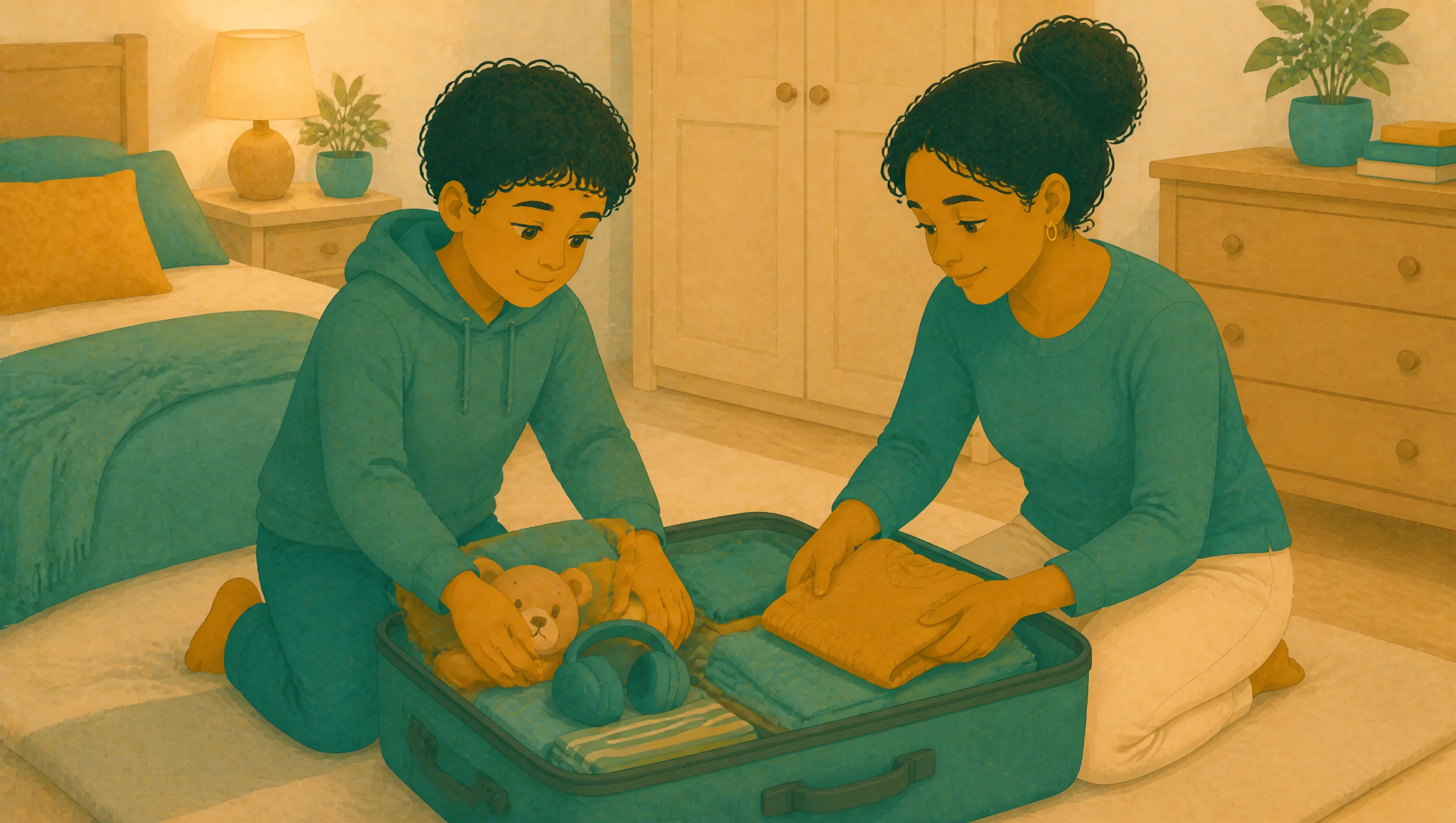
Put essential items where an adult can reach them without emptying the whole bag. Depending on the journey, that might include:
- medication, prescriptions and necessary documents;
- communication aids and a back-up method;
- familiar food and an empty refillable bottle for after security;
- headphones, ear defenders, sunglasses or a cap;
- a small comfort item;
- spare clothes and personal-care supplies;
- charger, cable and power bank within transport rules;
- one familiar activity and one low-effort back-up; and
- booking details, addresses and emergency contacts.
Check operator rules for batteries, liquids, food and equipment. Avoid introducing several new sensory products on the travel day. A familiar object with a known purpose is usually easier to use than a carefully packed kit the child has never tried.
For a compact list, see what to pack for a day out when a child needs sensory support.
Plan adults' jobs before the busy parts
If two adults are travelling, decide who handles documents and staff conversations and who stays available to the child. Agree who watches siblings when bags are searched, somebody uses the toilet or one person needs to step away.
With one adult, reduce what must be managed at once. Use luggage that leaves a hand free, keep documents in one secure place and ask assistance staff what help they can provide. Tell older children the meeting point and the adult's phone number without shifting responsibility for a distressed sibling onto them.
During boarding, choose the option that fits the child. Boarding early can provide time to settle before aisles fill. Boarding later can reduce time confined in the seat. Ask what the airline can arrange and explain the trade-off to your child.
Prepare for delays and changes
A delay plan should answer four questions:
- Where can we move away from the busiest area?
- Which food, medicine and personal-care items must remain accessible?
- How will we explain the next update?
- At what point will an adult ask staff for further help?
Do not fill an unexpected hour with extra shops and activities by default. Waiting may already require sustained effort. Offer a familiar activity, movement where it is safe, food, quiet or no conversation, according to what helps this child.
On a car or train journey, name planned stops and what would trigger an additional one. Make clear which safety rules cannot change. A seat belt, remaining in a safe area and following an evacuation instruction are fixed. The choice can sit around clothing, music, food, the order of activities or whether to speak.
If disruption means an overnight stay, keep the first plan small: essential food, medication, washing and sleep. Solving the whole holiday while everybody is exhausted can wait.
Leave room after arrival
Arrival is another transition, not proof that the hard part has finished. The room may smell unfamiliar, bags may be delayed and adults may want to begin the holiday immediately.
Show the child the toilet, sleeping place and where familiar belongings will go. Offer food and drinking water. Keep the first hours lightly planned and avoid requiring an enthusiastic response to the destination.
When you plan the holiday around the family's actual needs, include the journey in the total cost. An outward flight that was manageable may still justify a quiet first day. What you learn on the way out can be used to simplify the return journey.
Sources and further reading
- [1] Civil Aviation Authority. How to access help and support when travelling by air (accessed 4 August 2026).
- [2] UK Government. Airport and airline accessibility rights (accessed 4 August 2026).
- [3] UK Government. Air passenger travel guide (accessed 4 August 2026).
- [4] UK Government. Take medicine in or out of the UK (accessed 4 August 2026).
